
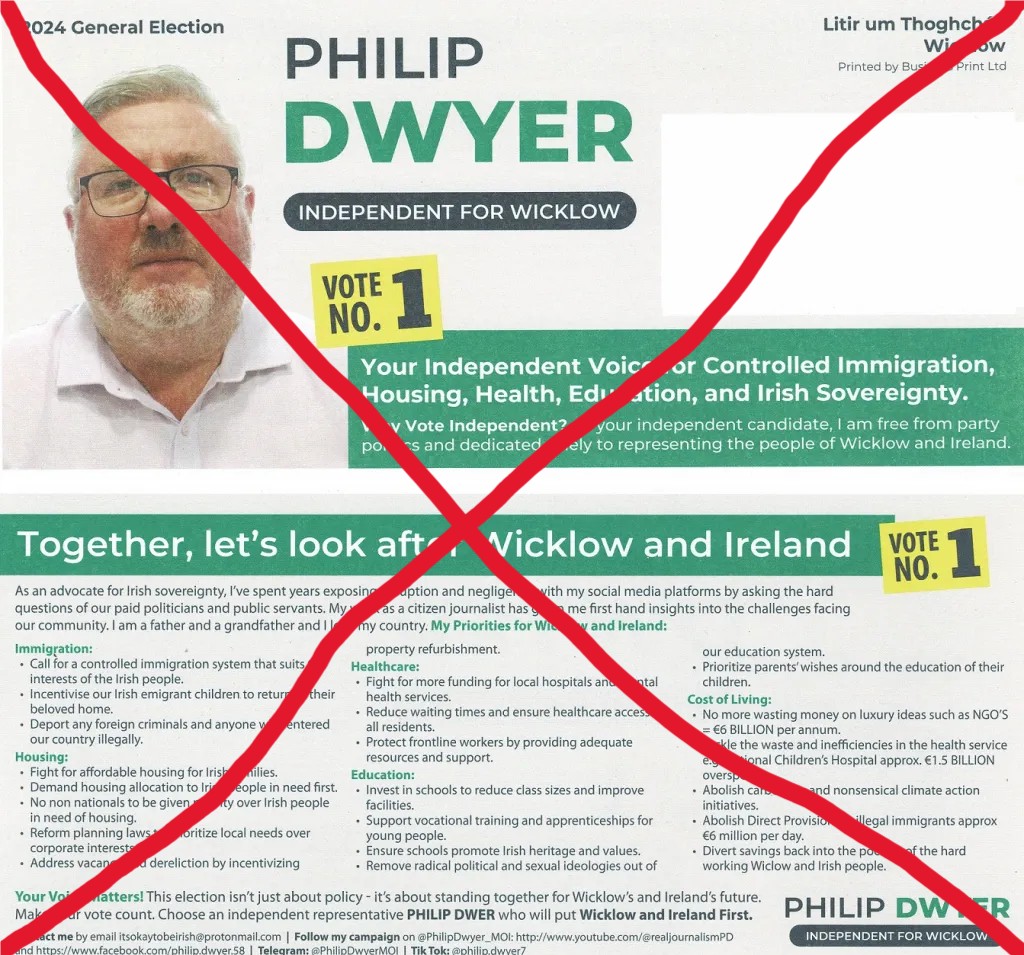
Philip Dwyer has built an entire public identity around finding someone to blame. Whether filming outside schools, confronting crèche owners, livestreaming Pride events or chasing politicians with a selfie stick, he returns to the same target over and over again. Transgender people. Pride flags. LGBTQIA+ communities. It has become an obsession.
Dwyer has spent years cultivating the image of an independent journalist, despite possessing neither the qualifications nor the professional standards normally associated with the role. His self-appointed title of ‘citizen journalist’ has allowed him to present political campaigning as objective reporting. Dwyer’s work demonstrates the opposite of journalism. His videos begin with a conclusion already decided, seek only evidence that confirms it, and dismiss any challenge as part of a wider conspiracy. What he produces is propaganda, with his platform serving as a political weapon rather than a tool for informing the public.
Ireland faces a housing crisis, an overstretched health service, rising costs, deep inequalities and communities struggling to make ends meet. Yet Dwyer repeatedly presents rainbow flags as though they represent some existential national emergency.
Dwyer has repeatedly associated queer people with paedophilia and grooming. He has repeatedly claimed that queer people are paedophiles, that Pride flags exist to groom children, and that transgender people are mentally ill.
However, he is incapable of supporting any of his arguments. One of the clearest illustrations of Dwyer’s incompetence came during his appearance on the Opinions Matter with Adrian & Jeremy podcast in June 2026. Invited on to explain why he believed a Pride flag flying outside Tallaght University Hospital was offensive, Dwyer claimed the rainbow flag was anti-Christian, anti-family and pro-abortion. As the discussion continued, he insisted there were only two genders, described transgender people as suffering from a genuine mental illness, alleged that schools were indoctrinating children into transgender ideology, and argued that children should not have same-sex parents. Rather than substantiating these claims with evidence when challenged by the presenters, the discussion repeatedly drifted into broader conspiracy narratives involving the World Health Organization, Covid-19 and what he termed degenerate ideology. The interview demonstrated how Dwyer’s anti-trans rhetoric, like his political career, is not built upon evidence or policy analysis, but upon a familiar collection of international Far Right talking points that are recycled regardless of the subject under discussion.
His willingness to embrace extreme anti-trans messaging was best illustrated by his collaboration with former boyband member Callum Lapsley. Rather than distancing himself from childish content that openly mocked and vilified trans people, Dwyer chose to appear in Lapsley’s productions, including the transphobic My Girl is Far Right and a subsequent live comedy show in February 2026. Far from presenting himself as a serious political commentator or citizen journalist, Dwyer was happy to become part of the performance. It demonstrated that his hostility towards trans people extends beyond political campaigning into entertainment. Many venues cancelled after becoming aware of the nature of the material, and when the production finally reached the stage, attendance was minimal. Even sections of the far right openly mocked the production, leaving Dwyer ridiculed not only by his political opponents but by parts of the movement he sought to entertain.
Among Ireland’s fragmented far-right movement, Dwyer has occupied an unusual position. He has survived feuds that destroyed relationships between many of its leading personalities, while publicly distancing himself from figures such as Derek Blighe when they became politically inconvenient. His criticism of Mike Connell only emerged after rhetoric involving child rape turned inward and threatened the movement’s public image rather than when years of abuse targeted LGBTQIA+ people. The line was apparently crossed only when it became electorally embarrassing.
Philip Dwyer’s relationship with the Fascist National Party illustrates the instability that has characterised much of Ireland’s organised far right. He stood as a National Party candidate in the 2020 General Election before becoming one of the party’s more recognisable public faces through his livestreams and the Men of Ireland hiking group. However, his growing profile also created tensions within the party. Following widespread criticism of his decision to stage a political speech at the grave of murdered schoolteacher Aisling Murphy in early 2022, Dwyer announced that he had been expelled from the National Party, claiming the controversy was merely a pretext for internal power struggles.The dispute reflected a deeper rivalry with party leader Justin Barrett, with Dwyer’s growing online following viewed as a challenge to Barrett’s authority. The split was accompanied by bitterness, resignations and public recriminations, yet Dwyer never truly distanced himself from the movement’s politics. Although outside the party, he continued to platform National Party members and remained embedded within Ireland’s wider far-right network. He appears careful never to burn every bridge, perhaps recognising that his political relevance depends less on leading a movement than on remaining useful to whichever faction currently holds influence.
Philip was present throughout the recent anti-Pride protest organised by Malachy Steenson, that was promoted as a National Rally. The event sought to frame itself as a defence of normal queer people while arguing that Pride had been hijacked by the transgender movement. Speakers, including Steenson and Gavin Pepper expressed support for recent anti-trans interventions in the Dáil, portraying transgender rights as incompatible with the wider LGBTQIA+ movement. Yet the rally itself drew only a relatively small crowd, numbering a few hundred people, despite being promoted as a national mobilisation. Afterwards, Dwyer filmed a visibly disappointed Steenson attempting to explain the turnout by pointing to competing events across Dublin, including football fixtures and the city’s official Pride celebrations. The Far Right were flailing while tens of thousands celebrated Pride across the capital.
Dwyer presents himself as a defender of Irish identity and heritage, yet one of his most widely remembered public moments came when fluent Irish speaker Darragh Adelaide responded to him entirely through Gaeilge. Dwyer was left unable to continue the exchange before resorting to asking whether Adelaide had been sent by an NGO. The episode went viral. It was a reminder that claiming ownership of Irish identity is much easier than embodying it.
Philip consistently portrays himself as the victim of establishment censorship while operating social media platforms, fundraising through supporters and repeatedly attracting media attention. He presents himself as an outsider while remaining one of the most recognisable figures in Ireland’s anti-immigration and anti-LGBTQIA+ ecosystem.
The legal history surrounding Dwyer involving confrontations at a crèche, public order convictions, trespass, election incidents or courtroom appearances, conflict seems to follow him with remarkable consistency. The broader picture is one of an activist who repeatedly places confrontation at the centre of his public persona.
Philip Dwyer is simply another loud voice on social media. His fixation on transgender people reveals the emptiness at the heart of Far Right politics. He represents a style of politics that depends upon identifying ever smaller and more vulnerable minorities to blame for society’s problems. He has spent years searching for someone to blame. Refugees. Pride flags. Queer people. Transgender people. But none of them caused Ireland’s housing crisis. None of them created overcrowded hospitals or rising living costs. His politics offers no meaningful solutions because it was never designed to solve problems. It exists to manufacture enemies. That may generate livestreams, donations and headlines, but it leaves Ireland exactly where it started, still facing its real challenges while one of its smallest minorities is turned into a convenient scapegoat.
Read More:
- Ken O’Flynn: Using the Memory of Murdered Gay Men to Attack Trans People
- The Network Behind Women’s Space Ireland
- Niamh Uí Bhríain Repeal to Repression: How Niamh Uí Bhriain Recycled Ireland’s Defeated Anti-Abortion Machine into an Anti-Trans Campaign
- Helen Joyce From Trinity to Targeting Trans Lives: Helen Joyce and the Hypocrisy Ireland Keeps Importing
- Graham Linehan Why is Graham Linehan So Vehemently Anti-Trans?
- The Countess The Countess Exposed: Corporate Structure and Anti Trans Politics
- Natural Women’s Council The Natural Women’s Council and the politics of organised intimidation
- Wicklow Women4Women
- Sharon Keogan
- Peadar Tóibín
- Ken O’Flynn
- Linda de Courcy
- Shaun Crowe
- Derek Blighe
- Paddy O’Gorman
About Sorcha Rosa
Sorcha Rosa is an intersex activist, writer and former elite cyclist based in Dublin. Through Simply Sorcha, she investigates the growing influence of Ireland’s far-right movement, anti-LGBTQIA+ campaigning and the politics of the international culture war. Her work combines investigative research, political analysis and lived experience to examine the organisations, personalities and narratives shaping public debate.
Alongside her writing, Sorcha is Secretary of Intersex Ireland and has contributed to national and international discussions on transgender and intersex rights, healthcare, sport and equality. She is a regular public speaker and commentator on human rights, with a particular focus on exposing misinformation, defending marginalised communities and documenting the networks behind organised anti-trans activism.
More of her work can be found at Simply Sorcha, where she publishes in-depth investigations, opinion pieces and analysis on politics, equality and social justice.