
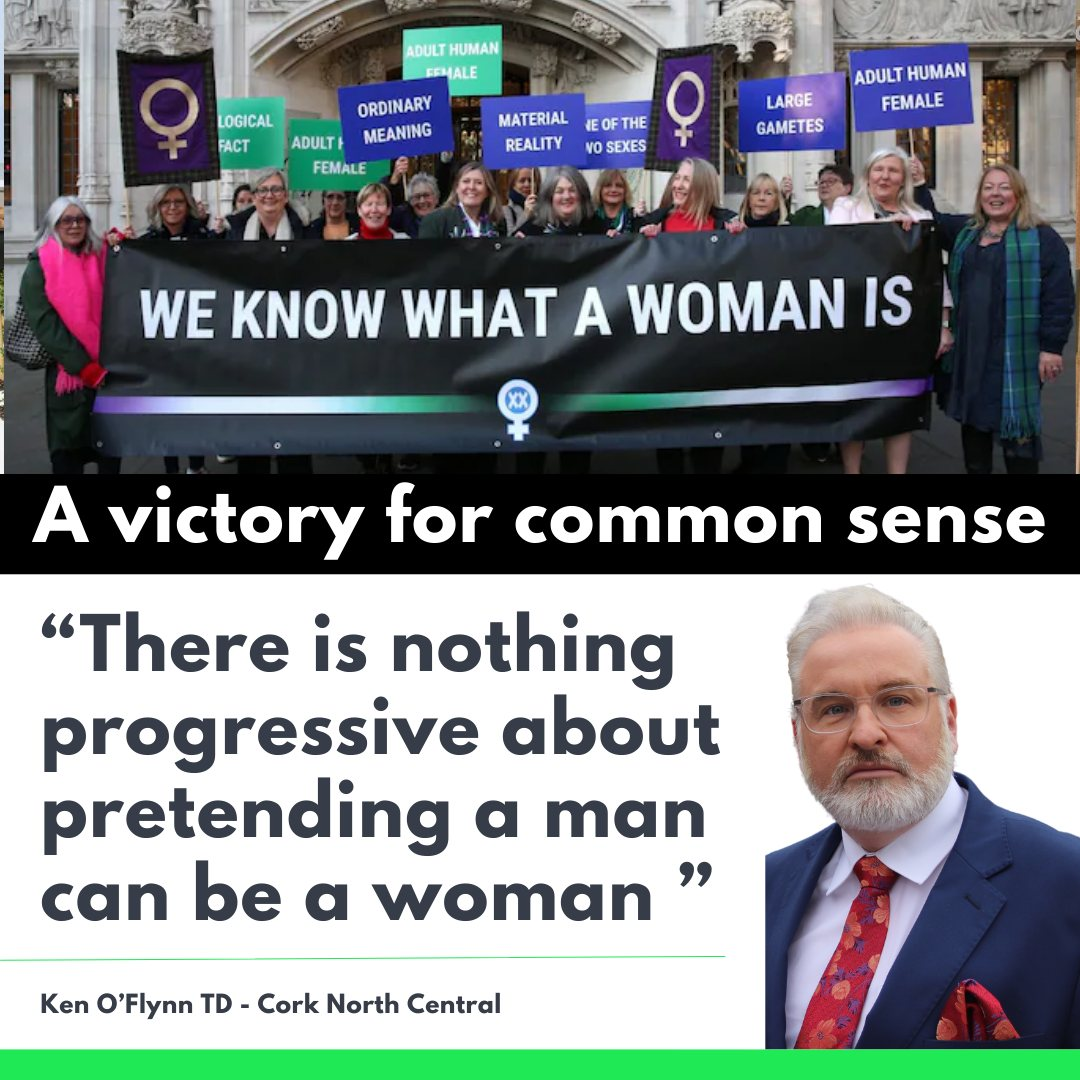
Is anyone surprised by the trajectory of Ken O’Flynn’s political rhetoric. What began as Dáil questions framed around transparency and oversight has developed into a sustained campaign of speeches, statements, and public messaging that closely mirrors the language of organised anti-trans activism. In much the same way that Graham Linehan lost himself in a campaign against a vulnerable minority, Flynn seems to be a few steps behind on the same path. For those directly affected, this feels like a deliberate political effort to question the legitimacy of transgender lives in Irish society.
The tone of that rhetoric has become steadily more explicit. O’Flynn has repeatedly used phrases such as “What is a woman?” and statements asserting that there are only two sexes, language that has become a standard slogan within gender-critical campaigns internationally. These phrases function as political signals that reject the existence of transgender identities and frame legal recognition as a form of ideological deception. When they are repeated in Irish political discourse they bring with them the same culture war framing that has dominated debate in the United Kingdom and parts of the United States.
This is particularly visible in O’Flynn’s public statements celebrating international legal decisions that undermine transgender rights. Following a UK court ruling on biological sex, he described the outcome as “a victory for common sense” and praised it as proof that what he called “biological truths” were being restored after being suppressed by “radical gender ideology.” Statements like these position transgender rights as an ideological threat and portray recognition of trans people as something society must correct or reverse.
For many in the trans community, this rhetoric echoes older moral narratives that have long been used to police gender and sexuality. Assertions that biological sex is a timeless and universal truth recognised across all cultures and centuries draw heavily on rigid, colonial, capitalist and religiously influenced ideas about gender roles and social order. Ireland has spent decades moving away from political structures where moral authority was used to regulate people’s identities and bodies. Hearing these themes resurface in Dáil debate feels to many like a deeply unsettling return to that past.
The language used has also crossed into open caricature. In a speech at a gender critical event attacking the Gender Recognition Act 2015, O’Flynn referred to a man in a dress with a beard while discussing Mother’s Day. Comments like this reduce trans women to stereotypes designed to provoke ridicule and suspicion. When a public representative uses language that invites people to see transgender women as absurd or deceptive, it helps normalise the hostility that trans people already face in everyday life.
These statements also sit within a wider political network that has become increasingly visible. O’Flynn has appeared alongside prominent gender-critical activists such as Helen Joyce and Stella O’Malley, both of whom have built international platforms opposing transgender rights. He has also repeatedly aligned himself with Linda de Courcy, a councillor whose activism combines opposition to transgender rights with anti-immigration narratives framed around protecting women and children. Many of these networks intersect with organisations such as Sex Matters, which campaigns internationally against legal gender recognition and transgender inclusion.
A recurring feature of O’Flynn’s messaging is the attempt to frame these positions as concern rather than hostility. Social media posts and Dáil statements frequently emphasise transparency, patient safety, safeguarding, and protecting children. In one message about gender healthcare services for young people he insisted that the issue was “not about ideology” while calling for oversight and outcome monitoring. Yet for many trans people this framing is immediately recognisable. Across Europe and North America, the same language has been used repeatedly as the entry point for campaigns seeking to restrict gender affirming healthcare. The rhetoric shifts the conversation away from the wellbeing of transgender people themselves and towards hypothetical risks and fears.
That pattern is reinforced through Dáil parliamentary questions. On 4 November 2025 O’Flynn raised multiple questions to the Minister for Education and Youth about how gender identity is discussed in schools. The questions centred on detransition, parental rights, and the possibility that children might regret exposure to information about gender identity. By focusing heavily on rare cases of regret while ignoring the experiences of transgender young people who benefit from supportive environments, the narrative presented to the public becomes one of danger rather than understanding.
The same themes appear in questions directed to the Minister for Health regarding gender services. O’Flynn has repeatedly argued that Ireland’s approach to gender affirming care lacks evidence and oversight, frequently referencing the flawed Cass Review as justification for caution. While the review concerns healthcare services in England, it has become a central talking point within gender-critical activism across Europe. Its repeated use in Irish political debate suggests a conscious attempt to import the culture war framing that has reshaped policy discussions in Britain.
His rhetoric has also extended to accusing political opponents and government ministers of engaging in what he describes as “trans activism.” In one statement he questioned whether a minister supporting healthcare services for transgender young people could be breaching the Code of Conduct for Office Holders, suggesting that engagement with organisations supporting trans youth might represent undue lobbying. For trans people watching these debates unfold, the implication is clear. Advocacy for their healthcare and wellbeing is being reframed as political interference rather than legitimate representation.
Another striking feature of this discourse is his obsessive focus on trans women. References to prisons, sports, bathrooms, and women’s spaces dominate the conversation. Trans men are almost entirely absent. This selective focus mirrors international anti-trans narratives in which trans women are portrayed as threats while trans men are rendered invisible. The strategy depends on constructing fear. It presents transgender women as a danger to others rather than as individuals seeking dignity and safety.
Ireland has often been recognised internationally for making meaningful progress in recognising transgender people’s rights. The passage of the Gender Recognition Act in 2015 allowed adults to have their gender legally recognised through self declaration and reflected a broader cultural shift towards respecting autonomy and dignity. For many in the trans community, the increasing prominence of rhetoric attacking that recognition feels like a deliberate attempt to roll back those gains.
Political scrutiny of healthcare and education policy is legitimate. Governments should be questioned and policies should be examined. But when scrutiny consistently targets a single minority group, when the language used reduces that group to stereotypes, and when those arguments mirror organised campaigns seeking to remove their rights, it stops looking like neutral oversight.
For many transgender people in Ireland, the current moment feels less like a debate about policy and more like the beginning of a familiar political pattern. Minority communities are turned into cultural battlegrounds in the name of tradition, biology, or protecting children. Ireland has seen this dynamic before. Many campaigners like Flynn hide behind religious beliefs and ideology. The hope within the trans community is that the country will recognise it sooner rather than later, and not allow a vocal minority drag us back to the dark ages of Catholic oppression.
Read More:
- Using the Memory of Murdered Gay Men to Attack Trans People
- The Network Behind Women’s Space Ireland
- Niamh Uí Bhríain Repeal to Repression: How Niamh Uí Bhriain Recycled Ireland’s Defeated Anti-Abortion Machine into an Anti-Trans Campaign
- Helen Joyce From Trinity to Targeting Trans Lives: Helen Joyce and the Hypocrisy Ireland Keeps Importing
- Graham Linehan Why is Graham Linehan So Vehemently Anti-Trans?
- The Countess The Countess Exposed: Corporate Structure and Anti Trans Politics
- Natural Women’s Council The Natural Women’s Council and the politics of organised intimidation
- Wicklow Women4Women
- Sharon Keogan
- Peadar Tóibín
- Ken O’Flynn
- Linda de Courcy
- Shaun Crowe
- Derek Blighe
- Paddy O’Gorman
About Sorcha Rosa
Sorcha Rosa is an intersex and transgender writer, campaigner and public speaker based in Dublin. She is Secretary of Intersex Ireland, a member of ROSA Socialist Feminist Movement, and an advocate for LGBTQIA+, sex workers’ and human rights. Her writing focuses on exposing the networks, rhetoric and political strategies driving anti-trans organising in Ireland, placing them within their wider international context. Drawing on lived experience alongside political analysis, she writes about gender, feminism, healthcare, equality and the growing influence of culture-war politics. Through Simply Sorcha, she combines investigative commentary with personal reflection, challenging discrimination while documenting the realities facing trans and intersex people in contemporary Ireland.