
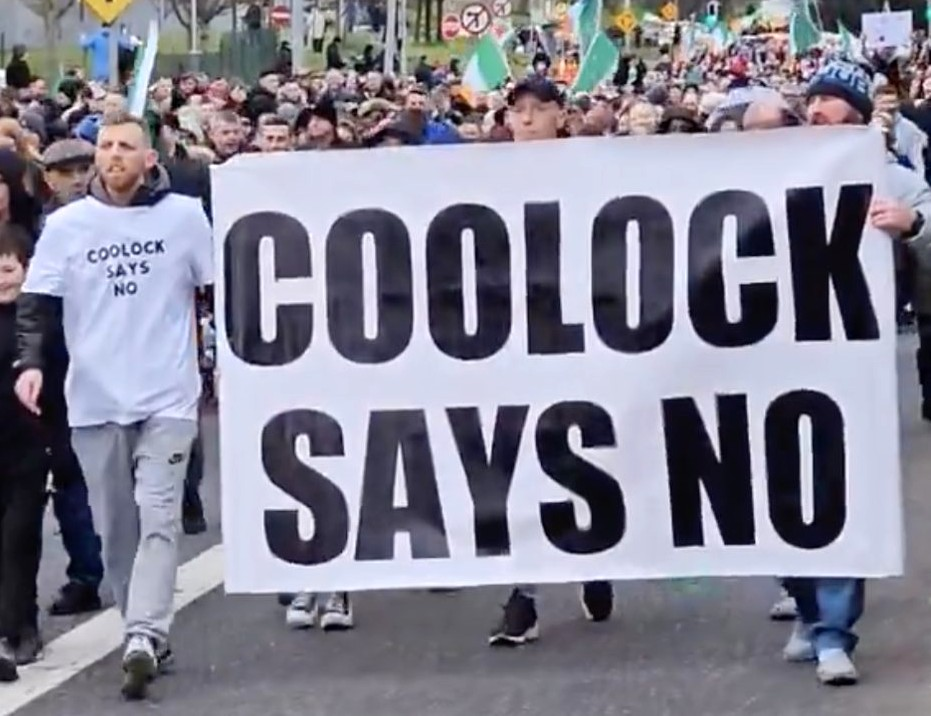
Irish Far Right protest politics repeats itself: violence is celebrated when it is useful and disowned when it becomes inconvenient. In the wake of the 2024 unrest around the Crown Paints site in Coolock, Shaun Crowe, also known as Sean Rush, became highly visible within the ‘Coolock Says No’ mobilisation. He was a constant presence on livestreams, at protests, and across Telegram and TikTok channels aligned with the anti immigration movement. For a period he was welcomed on platforms and protest stages. Today he stands largely isolated.
Movements that begin in confrontation often attempt to evolve into electoral forces, and when that shift begins from megaphone to manifesto the criteria for usefulness change. Street escalation becomes reputational risk. The High Court injunctions issued in July 2024 against protest figures marked a turning point because legal scrutiny reframes activism in the language of public order and compliance. Those seeking office must project lawfulness and discipline, even if their rise depended on confrontation. It was in this context that Crowe’s public fallout with Malachy Steenson became increasingly visible.
The rupture between Crowe and Malachy Steenson crystallised as the movement attempted to transition from protest mobilisation to electoral positioning. Crowe publicly accused Steenson and his supporters of coordinating with administrators of the ‘Patriots of Éire’ page on X, with allegations of infiltration and betrayal. He used phrases such as MI5 and rat to describe those he believed had undermined him. Steenson did not engage with these accusations. Instead he adopted a strategy of non response, positioning himself as an elected representative focused on politics rather than internal disputes. Silence in this context functioned as reputational distancing. Malachy spoke from council chambers. Shaun continued speaking primarily through livestream feeds.
The fracture widened further during the 2024 General Election period with tensions involving the Irish Freedom Party. The party sought to consolidate itself as a serious electoral entity, which required message discipline and reputational control. Crowe’s confrontational style and public disagreements placed him outside that structure. By late 2024 he was no longer operating within the same political infrastructure as Steenson aligned activists or elements of the Irish Freedom Party. Whether described as excommunication or strategic distancing, the outcome was the same. They moved forward without him.
In addition to factional disputes in Dublin, Crowe’s participation in protests in Belfast generated controversy within sections of the Irish anti immigration right. His presence at events where British unionist symbolism and loyalist messaging were visible was criticised by some activists who identify with a republican nationalist tradition. For those on the right who frame their politics in Irish sovereignty terms, any perceived proximity to British unionism and the Butchers Apron created discomfort and internal debate. While Crowe did not formally declare an ideological shift, he spoke of uniting the people against a common enemy, critics within his broader camp argued that the optics of such alignment sat uneasily with the movement’s stated nationalist rhetoric. The episode deepened existing fractures and highlighted the ideological inconsistencies that emerge when street mobilisation crosses historical and constitutional fault lines.
The fallout produced proxy conflicts that signalled fragmentation rather than growth. Crowe has claimed that individuals linked to rival factions engaged in online targeting of his partner, claims that have been denied or dismissed by others in the movement. No court findings have publicly established those allegations. What is observable is the shift from outward mobilisation to inward accusation. Once a movement begins debating infiltration, betrayal and loyalty it is no longer consolidating power. It is fragmenting. The language of MI5 functions less as evidence and more as a signal that trust has collapsed.
Crowe has also publicly criticised the rapist Conor McGregor following reports that a property previously owned by the fighter was sold for use in housing. In online posts he described this development as a betrayal and framed it as inconsistent with anti immigration rhetoric. He was a vocal supporter of McGregor during his rape trial. The episode illustrates that populist movements elevate symbolic allies conditionally. When those figures make commercial or pragmatic decisions that do not align perfectly with ideological expectations, accusations of treachery quickly follow.
In recent online commentary Crowe has referenced the case of Randy Gladstone, a high profile 2024 to 2025 criminal case involving an asylum seeker, and contrasted it with civil proceedings involving Conor McGregor. The comparison is framed to suggest that trans activists and civil society organisations apply a double standard, vocal in one case and selective in another. This rhetorical strategy reduces complex judicial proceedings to a binary of outrage versus silence. Public accountability, however, applies universally. Crowe himself was arrested in 2024 and charged in connection with possession of a Stanley knife during protest activity, a matter of public court record that was widely reported at the time. That arrest became part of the broader legal scrutiny surrounding the protests and reinforced the reputational risks facing those seeking to professionalise the movement. Invoking legal cases as political ammunition while dismissing scrutiny of one’s own court history illustrates the selective framing that often emerges when movements fragment.
As alliances deteriorated, personal targeting intensified and I experienced this directly. In the Dublin protest scene, I and many others have been used repeatedly in online posts and protest footage to single us out. Community monitoring groups such as Ireland Against Fascism have documented instances where my name and image were circulated in ways designed to provoke hostility. At protests in Coolock and Belfast my name has been shouted publicly. I have been labelled a paid agitator because of my then professional role and a threat to children because I am a LGBTQIA+ activist.
In online posts Crowe has used the terms NGO puppet and paid NGO to describe my activism. This framing is a common populist trope that casts civil society advocates as part of a state funded elite while positioning the speaker as representing the real community. It is a convenient narrative when political alliances collapse. If a movement loses cohesion, it is easier to accuse opponents of being funded agents than to acknowledge internal fracture. My work is transparent and publicly documented. Advocacy for women’s health, trans inclusion and intersex rights is accountable civil society engagement. Describing it as a conspiracy does not make it one.
What remains is a familiar political outcome that can be observed without speculation. A protest surge attempted to professionalise. Electoral actors distanced themselves from volatility and violence. Public disputes were framed in the language of betrayal and infiltration. Crowe has become an increasingly isolated activist, and has continued operating outside institutional structures. When figures like Malachy Steenson move toward institutional credibility and parties like the Irish Freedom Party enforce discipline, those unable or unwilling to recalibrate are left on the margins.
The episode involving Conor McGregor encapsulates the deeper dynamic at work. A movement that demands absolute alignment eventually consumes its own symbols. Street organisers become liabilities and conspiracy replaces coalition building. This is the self cannibalisation cycle. A movement that cannot tolerate divergence ultimately narrows itself into irrelevance, consuming its former champions along the way.
Crowe’s renewed activism this year has moved beyond commentary on social media. He is now attempting to promote a September mobilisation under the banner “Dublin Says No,” calling for an overnight occupation in Merrion Square and urging supporters to “Shut Down the City.” The AI promotional material goes considerably further than opposition to immigration policy, explicitly calling for Ireland to leave the European Union and inviting “Nationwide Says No groups & Patriots” to unite against what it describes as tyranny. It is an attempt to broaden his appeal beyond Coolock and present himself once again as a national organiser rather than an increasingly isolated protest figure.
He has also reignited his attack on Steenson, with an online video claiming betrayal of Coolock Says No. Crowe is attempting to place himself back at the centre of a movement that has largely evolved without him. His recent surge of posts, renewed attacks on former allies, promotion of new alternative demonstrations and increasingly national rhetoric all point in the same direction: a determined effort to reclaim political relevance. The same networks that once celebrated him now contain many of his fiercest critics. Shaun Crowe spent years helping build a movement that thrived on identifying traitors, infiltrators and enemies within. Today, he finds himself trying to win back the approval of that very same movement. Eventually, they begin consuming themselves.
Read More:
- Ken O’Flynn: Using the Memory of Murdered Gay Men to Attack Trans People
- The Curious Rise of Róisín Michaux
- Bullying Victim to Bully: How Niall Boylan Built a Career Targeting Trans People
- Philip Dwyer: A Career Built on Hating Trans People.
- The Network Behind Women’s Space Ireland
- Niamh Uí Bhríain Repeal to Repression: How Niamh Uí Bhriain Recycled Ireland’s Defeated Anti-Abortion Machine into an Anti-Trans Campaign
- Helen Joyce From Trinity to Targeting Trans Lives: Helen Joyce and the Hypocrisy Ireland Keeps Importing
- Graham Linehan Why is Graham Linehan So Vehemently Anti-Trans?
- The Countess The Countess Exposed: Corporate Structure and Anti Trans Politics
- Natural Women’s Council The Natural Women’s Council and the politics of organised intimidation
- Wicklow Women4Women
- Sharon Keogan
- Peadar Tóibín The Danger Already Inside The Room
- Ken O’Flynn Using The Memory Of Murdered Gay Men To Attack Trans People
- Linda de Courcy
- Shaun Crowe
- Derek Blighe
- Paddy O’Gorman From Tights To Fragile Masculinity