
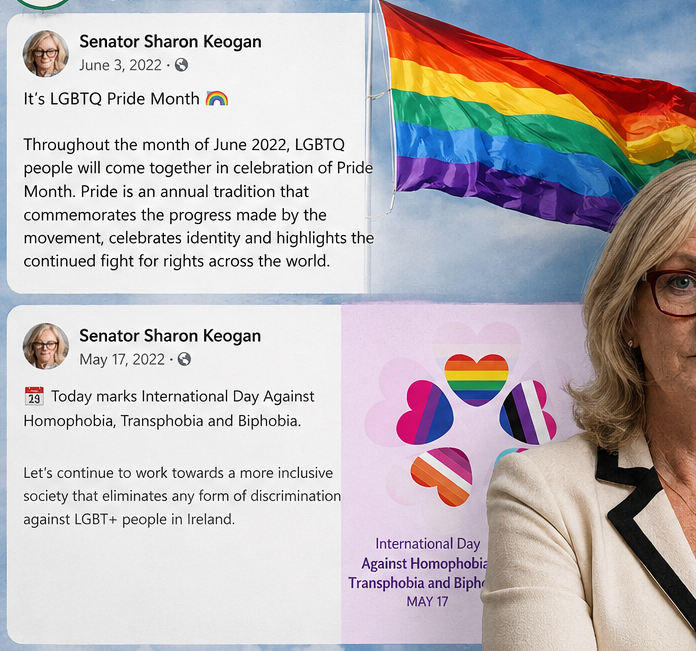
In June 2022, Senator Sharon Keogan marked Pride Month with a simple message. “Throughout the month of June 2022, LGBTQ people will come together in celebration of Pride Month. Pride is an annual tradition that commemorates the progress made by the movement, celebrates identity and highlights the continued fight for rights across the world.”
A few weeks earlier, on International Day Against Homophobia, Transphobia and Biphobia, she wrote: “Let’s continue to work towards a more inclusive society that eliminates any form of discrimination against LGBT+ people in Ireland.”
Those statements now sit uneasily beside the political record that followed. Over the past several years, Keogan has emerged as one of the most prominent gender-critical voices in Irish politics. She has repeatedly criticised transgender rights, questioned gender-affirming healthcare for young people, opposed self-identification under the Gender Recognition Act, challenged the inclusion of trans women in women’s sport and women’s spaces, criticised workplace pronoun policies, and appeared at conferences dedicated to opposing gender recognition and transgender inclusion.
What we can see is a politician who has increasingly dedicated her political capital to targeting one of the smallest and most vulnerable minorities in Irish society. Keogan has repeatedly argued that children should not be socially or medically transitioned and has criticised puberty blockers and gender-affirming healthcare. She frames these interventions as safeguarding measures.
During debates on hate speech legislation, she became widely known for spending approximately twenty-five minutes reading lists of gender identities in the Seanad. She argued that the legislation was vague and overly broad. Her performance was a deliberate attempt to mock transgender and non-binary people while undermining legal protections against hatred.
She has repeatedly criticised workplace policies encouraging the use of preferred names and pronouns, arguing that such policies conflict with beliefs about biological sex and freedom of conscience.
She has called for aspects of Ireland’s Gender Recognition framework to be repealed or fundamentally reconsidered and has become one of the most visible political opponents of gender self-identification in the country.
Keogan has repeatedly shared platforms with prominent gender-critical campaigners, including Helen Joyce and Stella O’Malley. She has appeared at conferences questioning the Gender Recognition Act and events dedicated to opposing transgender inclusion. She has become a regular participant in a wider network of activists, commentators and campaigners whose central political concern is opposition to contemporary understandings of gender identity
She is following a well worn path, opposition to transgender rights, opposition to inclusive sex education, opposition to hate speech legislation, hostility towards immigration, suspicion of all diversity and equality initiatives.
She appeals to Far Right supporters of traditional values, traditional families and traditional social structures….
Keogan’s relationship with the rapist Conor McGregor illustrates this. While she never endorsed his presidential ambitions, she publicly defended his interventions on immigration and argued that he was giving voice to concerns ignored by mainstream politics. McGregor, in turn, repeatedly amplified her speeches and political messages to his enormous online audience. The overlap is obvious. Criticism of immigration. Criticism of political elites. Opposition to hate speech legislation. Opposition to progressive social change. Shared narratives about voices supposedly silenced by the establishment.
The significance of that relationship extends beyond immigration. Keogan frequently presents herself as a defender of women. For years she has argued that transgender inclusion threatens women and girls. She has repeatedly invoked women’s safety, dignity and rights as justification for opposing transgender equality.
Yet she also chose to publicly defend the political interventions of Conor McGregor after the rape and subsequent civil proceedings of Nikita Hand. Does that reflect a commitment to protecting women?
Sharon Keogan has the right to hold these views. Of course she does. But when a politician repeatedly campaigns against transgender rights, opposes gender recognition, attacks inclusive education, questions LGBTQIA+ initiatives, participates in gender-critical conferences, aligns herself with anti-immigration narratives, appears alongside figures associated with the European right, and presents social progress as a threat rather than an achievement, it becomes difficult to argue that she in not a Right Wing extremist.
The irony is that Sharon Keogan once stood publicly with the LGBTQIA+ community. She marked Pride. She spoke against discrimination. She acknowledged our existence and our right to dignity. Today, some of the most visible moments of her political career are built on opposing transgender rights, questioning gender recognition, attacking inclusive education and sharing platforms with those dedicated to rolling back the progress she once celebrated. There is little attention to be gained from standing with vulnerable people. There is far more to be gained from turning them into a problem. Sharon Keogan did not discover a Trans threat. She discovered an audience. And transgender people have paid the price.
Related Articles
- The Danger Already Inside the Room: Peadar Tóibín and Ireland’s New Respectable Right
- From Pilates to Panic Politics: The Wellness Branding of Ireland’s Reactionary Right
- The Countess Exposed
- Tights & Fragiule Masculinity
- Beyond the Binary: Intersex Liberation and the Fight for Bodily Autonomy
- We Were Never Meant to Be Invisible
- From Trinity to Targeting Trans Lives: Helen Joyce and the Politics of Respectability
- Why is Graham Linehan Anti Trans