
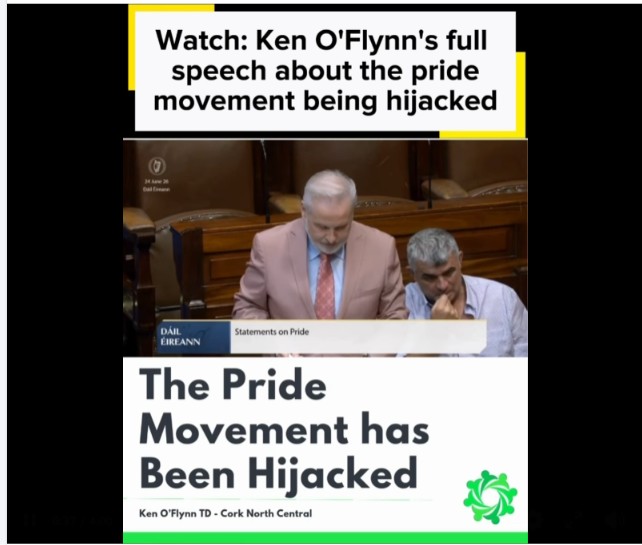
Ken O’Flynn’s Lowest Moment Yet: Weaponising the Dead Against Trans People
Ken O’Flynn stood in the Dáil during Pride Month and declared that he was speaking as a gay man. That is his right. What he does not have is the right to rewrite the history of our movement or pretend that transgender people somehow arrived as unwelcome guests at a struggle they helped build.
His speech was not a defence of gay rights. It was an attempt to divide one marginalised community against another. It borrowed almost every familiar talking point from the international anti-trans movement wrapped up in the language of nostalgia, patriotism and concern. If you ignore the Irish references – you could have been listening to any number of speakers from the British LGB Alliance.
None of this came as a surprise. Back in March, in my article What Is a Woman?: The Dog Whistles Behind Ken O’Flynn’s Anti-Trans Campaign, I argued that O’Flynn’s parliamentary questions and public statements were not isolated interventions but the early stages of a much broader strategy. I wrote that his repeated use of slogans such as “What is a woman?”, his attacks on gender recognition, and his growing alignment with prominent gender-critical activists pointed towards an increasingly explicit political campaign against transgender people. I warned that this rhetoric would likely evolve beyond policy debates into wider attacks on the LGBTQ+ movement itself. Three months later, that is precisely what has happened. The language has expanded from targeting trans people to claiming the entire LGBTQ+ movement has been hijacked, opposing Pride symbols, and drawing divisions between lesbian, gay and bisexual people and their transgender neighbours. The trajectory was not difficult to predict because it follows well-established international stategies.
The most cynical moment came when O’Flynn invoked the murders of Declan Flynn, Aidan Moffitt and Michael Snee. Their names deserve remembrance because they represent the terrible cost of anti-LGBTQ+ hatred in Ireland. But using murdered gay men as political cover while attacking another vulnerable minority is disturbing. Their memories should unite our community against hatred, not be weaponised to create new targets.
O’Flynn claims that today’s LGBTQ+ movement has been hijacked by transgender people. It is a remarkably dishonest reading of history. Trans, Intersex and gender non-conforming people have always existed, and have always been at the forefront of activisim.
The complaint about the ever-expanding list of letters is another tired Far Right slogan. It encourages people to see inclusion itself as a problem. As though acknowledging more human beings somehow diminishes everyone who came before.
The clearest dog whistle came with his comments about Pride flags and the Irish Tricolour. Nobody is replacing the Irish flag. Nobody is abolishing the Tricolour. Pride flags flown on public buildings during Pride Month are symbols of inclusion, just as countless other commemorative flags recognise different communities and events throughout the year. Presenting the Pride flag as somehow being in competition with the Irish flag is childish at best, and a direct import from UK extremism.
He suggested that government buildings should display only the Irish flag, and this echoes rhetoric increasingly common across nationalist and far-right movements internationally. It creates a false choice between being Irish and being LGBTQ+. As though queer Irish people somehow cease to be citizens the moment a rainbow flag appears beside the national flag.
His reference to Senator Eileen Flynn and the suggestion that the Tricolour is somehow viewed as frightening was another disgusting attack by a privileged white man against a woman who was brave enough to say how uncomfortable we all are with our National Flag used for hate. This follows a familiar pattern seen across the international far right, positioning yourself as the defender of ordinary people against an imaginary enemy.
What makes speeches like this particularly dangerous is that they are rarely presented as attacks. They often borrow the language of concern, moderation and free speech while repeatedly directing suspicion towards one tiny minority. That is precisely how prejudice often enters mainstream politics.
As an intersex trans woman, I recognise this pattern because history is full of it.
Pride exists because previous generations refused to allow politicians to define who belonged. Declan Flynn, Aidan Moffitt and Michael Snee are remembered because hatred kills. Their names should remind us of the consequences of division, not provide cover for creating new divisions within our own community.
Ken O’Flynn may believe he is speaking for the people who built this movement. He is not. The greatest threat to LGBTQ+ equality in Ireland has never been the inclusion of more people beneath the rainbow. It has always been those willing to convince us that our neighbour is the real enemy.
Read More:
- The Network Behind Women’s Space Ireland
- Niamh Uí Bhríain Repeal to Repression: How Niamh Uí Bhriain Recycled Ireland’s Defeated Anti-Abortion Machine into an Anti-Trans Campaign
- Helen Joyce From Trinity to Targeting Trans Lives: Helen Joyce and the Hypocrisy Ireland Keeps Importing
- Graham Linehan Why is Graham Linehan So Vehemently Anti-Trans?
- The Countess The Countess Exposed: Corporate Structure and Anti Trans Politics
- Natural Women’s Council The Natural Women’s Council and the politics of organised intimidation
- Wicklow Women4Women
- Sharon Keogan
- Peadar Tóibín
- Ken O’Flynn
- Linda de Courcy
- Shaun Crowe
- Derek Blighe
- Paddy O’Gorman
About Sorcha Rosa
Sorcha Rosa is an intersex and transgender writer, campaigner and public speaker based in Dublin. She is Secretary of Intersex Ireland, a member of ROSA Socialist Feminist Movement, and an advocate for LGBTQIA+, sex workers’ and human rights. Her writing focuses on exposing the networks, rhetoric and political strategies driving anti-trans organising in Ireland, placing them within their wider international context. Drawing on lived experience alongside political analysis, she writes about gender, feminism, healthcare, equality and the growing influence of culture-war politics. Through Simply Sorcha, she combines investigative commentary with personal reflection, challenging discrimination while documenting the realities facing trans and intersex people in contemporary Ireland.