
We built our identities through sport before we could live openly. Then the rules changed, the doors closed and the next generation saw what happened.
The generation of us who transitioned while still competing, or soon afterwards seems to have ended with a whimper. Something interesting happened in elite sport over roughly the past decade. A small number of already accomplished athletes began publicly transitioning or disclosing that they were transgender while they were still athletes.
Cycling produced several highly visible examples. Emily Bridges had already been through the British high-performance system before publicly coming out as transgender. Austin Killips reached elite international cycling under the eligibility rules that existed at the time. Other sports produced athletes such as swimmer Lia Thomas and runner CeCé Telfer. Their individual histories are different and shouldn’t be flattened into a single narrative. But there is a question we have barely asked about this generation. Why were some transgender people so deeply invested in sport before they transitioned? Most of the debate has concentrated on what happened afterwards. Almost nobody seems particularly interested in what sport meant to these people before anybody knew they were transgender.
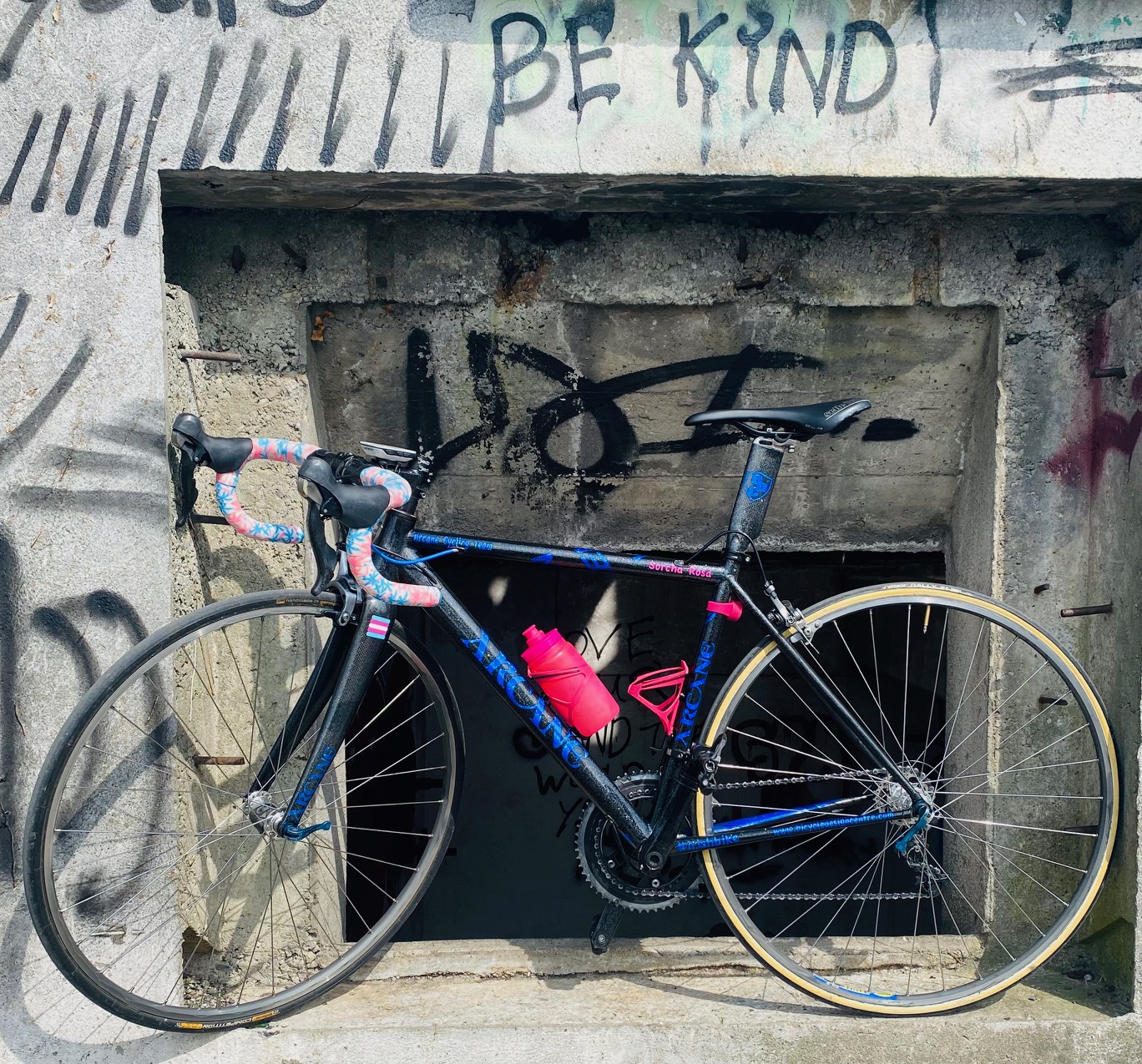
For most of my life, I was a cyclist. Not somebody who rode a bicycle and who raced at weekends. A cyclist. I trained for three or four hours a day, often alone. I raced at elite level. I became a national champion, more than once. I went on to coach, manage and work within the sport. Cycling has been a defining part of my life for more than forty-five years. Perhaps I have been looking at the story from the wrong end. Elite sport can provide an extraordinarily powerful identity. You don’t have to explain yourself when you are an athlete. You are a cyclist, swimmer. runner. Your body isn’t something mysterious that you need to understand. It becomes something measurable. Watts. Heart rate. Lactate. Weight. Recovery. Distance. Speed. And in men’s sport, athletic success can provide something else: an extraordinarily convincing performance of masculinity. I could succeed at being a man through sport in a way that I couldn’t succeed at it anywhere else. I could be tough enough, suffer enough, train harder and I could win. I don’t know how many other transgender athletes experienced sport that way. There is not enough research to allow me to say this with certainty, however there are clues.
Looking back at it now, though, I understand that cycling was doing something else for me. It gave me somewhere to hide. I wasn’t consciously thinking, “If I become good enough at cycling, nobody will realise I am different.” It was much more complicated than that. I didn’t pass particularly well as male in ordinary life. I always knew there was something different about me and my body. Men could see that difference too, even when none of us necessarily had the language for it. But on a bicycle none of that mattered. I could be the best man there. That sounds strange to write now, but it is true. In cycling I had an identity that nobody could question. I could perform masculinity through achievement. I was stronger, faster and harder than the men, nobody needed to ask what kind of man I was. I was the one winning.
Sport gave me legitimacy. It also gave me hours and hours alone. Anyone who has trained seriously for endurance sport knows those hours. Three hours. Four hours. Sometimes longer. Just you, the road, your breathing and the relentless repetition of turning the pedals. Those hours were extraordinarily good for me. They gave me time to think. Cycling regulated my mood. It gave structure to my days and purpose to my life. But there was another side to it. Training could also stop me thinking. There is a peace that comes from being completely exhausted. When your body is empty and your legs are destroyed, there isn’t much room left for the questions you don’t want to answer. You don’t have to think about gender. You don’t have to think about why your body feels different. You don’t have to think about why being a man seems to require a performance that everyone else appears to understand instinctively. You have tomorrow’s training programme. For me, cycling was simultaneously somewhere I could think and somewhere I could escape from thinking. And increasingly I wonder how unusual that really was.
Research into transgender people’s experiences of sport repeatedly describes concealment, stealth, passing and suppression of gender expression as ways of surviving within intensely binary sporting environments. A recent review describes transgender athletes continually negotiating whether they can exist within sport while having their identity recognised, and notes that remaining within sport can sometimes depend upon concealment rather than genuine acceptance.
What if, for some transgender people, extraordinary commitment to sport wasn’t separate from the struggle with gender? What if it was one of the ways we survived it? Then we came out. For a brief period, sport appeared to be finding ways of accommodating transgender athletes. The rules were complicated and frequently medicalised. Trans women were required to meet hormone thresholds and other eligibility criteria. Those rules were controversial, but there was at least a pathway.
Then the pathway started disappearing. In March 2023, World Athletics excluded transgender women who had experienced male puberty from female World Rankings competition. In July 2023, the UCI did essentially the same thing in international cycling. A trans woman who transitioned after male puberty could no longer compete in the women’s category on the UCI International Calendar. British Cycling created Female and Open categories, with trans women assigned to Open competition rather than the Female category. Swimming had already moved in the same direction. Lia Thomas challenged the World Aquatics policy and lost before the Court of Arbitration for Sport in 2024. One after another, the doors closed.
Something curious has happened since. Where are all the transgender athletes? Where is the invasion we were promised? We were told women’s sport was about to be overwhelmed. Commentators spoke as though enormous numbers of transgender women were waiting outside changing rooms for an opportunity to collect medals. Records falling, podiums being taken over and women’s sport becoming meaningless.
That invasion never arrived. Transgender athletes remained extraordinarily rare. Indeed, the American College of Sports Medicine stated in 2026 that transgender and gender-diverse people are underrepresented in sport. It also pointed to an important problem in the entire argument: there is remarkably little athlete-specific research on transgender people from which to make sweeping conclusions.
Now, I am seeing fewer transgender athletes trying. Nobody can currently produce a reliable graph showing the number of elite transgender athletes rising or falling year by year. So at present it is an observation. Perhaps the question isn’t: Why aren’t more transgender women succeeding in elite sport? But now, Why would they even start?
Imagine being a transgender girl or young woman who loves cycling. You look at the regulations and discover that if you experienced male puberty, there is no pathway into international women’s cycling. Why spend ten years trying to become an elite cyclist when you already know where the road ends? You wouldn’t enter the talent programme.
You wouldn’t spend your adolescence training towards a national championship when the governing body has already told you which category you will eventually be allowed to enter? Exclusion doesn’t necessarily produce thousands of rejected applications Maybe we simply stop presenting ourselves. Trans athletes are disappearing before anyone starts counting them.
There is another consequence to all this that I find increasingly disturbing. Having spent years warning about transgender women infiltrating women’s sport, sport has started looking for them. And increasingly the bodies caught in that scrutiny belong to women. The controversy surrounding Algerian boxer Imane Khelif is the obvious example. Khelif does not identify as transgender. She competed internationally as a woman and won Olympic gold in Paris. Yet she became the centre of an extraordinary international argument about whether she was sufficiently female to participate in women’s sport. World Boxing has now introduced mandatory sex testing for adult competitors, including genetic screening for competitors in the female category. This is where the politics of protecting women from transgender athletes takes us. We begin by looking for transgender women. Then we start looking for women who might secretly be transgender. Then women whose bodies don’t conform to our expectations become suspicious. Women with differences of sex development, Intersex women, women with naturally high testosterone, who are unusually muscular, women who don’t look feminine enough. Or women who are simply exceptionally good.
World Athletics demonstrates the overlap particularly clearly because its regulations deal separately with transgender athletes and athletes with differences of sex development. Its 2023 decision both excluded post-puberty transgender women and imposed testosterone requirements upon athletes covered by its DSD regulations.
When we went looking for the trans woman supposedly hiding in women’s sport, increasingly we found women whose biology was more complicated than the binary sporting system wanted it to be. And then we are making those women prove themselves.
There is another part of this debate that receives remarkably little attention. What happens to the trans person when we take her sport away. Sport wasn’t an optional extra in my life, and it wasn’t something I did for an hour on Wednesday evening because exercise is good for you. It was my life. It was everything.
You come out – and the institution that gave you identity tells you that there is no longer a place for you in the category in which you now live. This can mean losing a community, routine, ambition, social network and one of the principal mechanisms through which you have regulated your mental health. Research already tells us that discrimination and inequality in sport are associated with significant mental-health consequences for transgender people. A systematic review and meta-analysis published in 2024 found extensive discrimination affecting transgender athletes and identified serious associated mental-health problems.
Earlier research similarly identified the absence of inclusive and comfortable sporting environments as a major barrier to transgender participation. So perhaps we should stop treating participation in sport as though the only question that matters is who gets the medal. For some of us, sport is one of the things keeping us together.
As for the athletes who transitioned while already competing, perhaps we misunderstood what we were looking at. We saw an accomplished male athlete transition and asked: What advantage will this person bring into women’s sport? Maybe sometimes we should also have asked: Why did this transgender person become such an accomplished athlete in the first place? What was happening during those thousands of hours of training and what did achievement provide.
Cycling gave me somewhere to belong when I didn’t really understand where I belonged. It gave me an identity when mine was complicated, and it gave me masculinity when masculinity didn’t come naturally. We should ask former elite transgender athletes what sport meant before transition, and whether athletic identity allowed them to postpone confronting gender.
Maybe that generation of trans athletes was never the beginning of the great influx we were warned about. Maybe we were the end of something. We were a generation who had already spent years, sometimes decades, building an identity through sport before we finally understood ourselves, or felt safe enough to say who we were. For a short period, some of us believed we could transition and take that sporting life with us. Then the doors closed. The invasion never arrived. The podiums were never overrun. Women’s sport did not collapse. The enormous problem we were repeatedly promised simply did not materialise. Instead, the handful of trans athletes who had become so politically visible began to disappear from elite competition, and the next generation could see exactly what happened to them.
Perhaps that is where the question should begin now. Not with where all the trans athletes are hiding, but with why they would come at all. Why would a young trans cyclist devote ten years of her life to becoming an elite athlete when she already knows that the road ahead is closed? Why would she build her identity around a sport that has already told her there will eventually be no place for her? For me, cycling was somewhere to belong when I didn’t know where I belonged. It gave me purpose, masculinity, solitude, exhaustion and somewhere to put things I wasn’t yet able to understand. I became very good at it. Maybe other trans athletes did something similar. We should have asked what sport was doing for those people before we decided they were a threat to it. Instead we banned them, watched them disappear, and then began searching women’s bodies for the trans athletes who never came.
Further Reading:
- Ireland May Finally Recognise Non-Binary and Intersex People
- Ten Years On – Ireland’s Gender Recognition Act Still Leaves Us Behind
- We Have Never Been Silent: Speaking on Intersex Healthcare and Human Rights at RCSI
- When Ireland Spoke to the World: Meeting U.S. LGBTQI+ Envoy Jessica Stern
- We Were Never Meant to Be Invisible: Reflections from Bread and Roses 2026
- Why Should Non-Binary Cyclists Have to Lie to Participate?
- Anti-Fascism Must Include Bodily Autonomy
- Open letter from Arcane Cycling Team regarding gender options on the Cycling Ireland membership portal
- Rights Without Routes
- Athens, Boobs, and the Future of Intersex Rights
- Ireland Under Scrutiny: ECRI and the Fight for Trans & Intersex Rights
- Ireland’s First Intersex Cycling Champion
Leave a Reply