
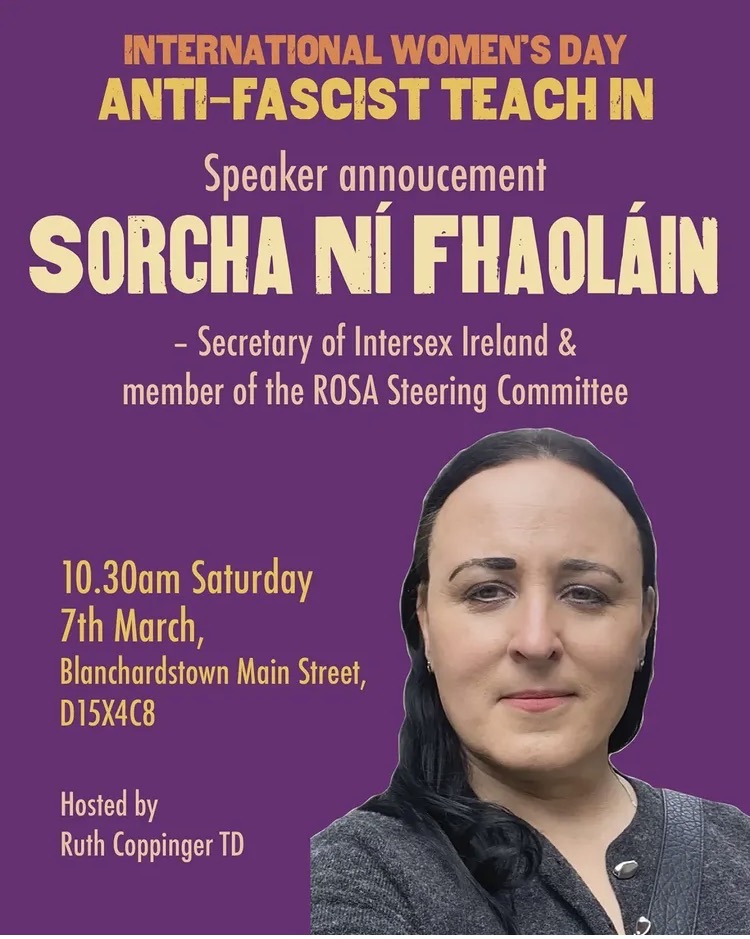
Speaking at an International Women’s Day anti-fascist teach-in in Dublin on intersex rights, bodily autonomy, and resisting the far right.
I spoke this week at an International Women’s Day anti fascist teach-in in Dublin, alongside Ruth Coppinger TD and a range of organisers, activists, and speakers working across anti racist, feminist, and queer movements. The event brought together people from different struggles with a shared focus on challenging misogyny, racism, and imperialism in the current political moment.
Ruth Coppinger spoke as part of the main forum, bringing a clear socialist feminist analysis and linking the rise of the far right to attacks on women’s rights, reproductive autonomy, and working class communities. Her contribution grounded the discussion in material politics and made clear that these attacks are not isolated issues but part of a wider system.
The earlier sessions included workshops led by activists with deep experience in their areas. Emer O’Neill, a broadcaster, author and anti racist activist, spoke about racism and how it is produced and maintained, and who benefits from it. Ollie Bell from Dublin Trans and Intersex Pride spoke about why fascist movements enforce rigid gender roles, linking historical patterns to what we are seeing now. Bairbre Kelly, from Therapists Against Harm, addressed how misogyny is embedded across systems, from online spaces to legal structures, and how survivors are organising against it.
These kinds of events matter. They create space for political education, for collective analysis, and for building connections across movements. At a time when reactionary politics is trying to isolate communities and fragment struggles, spaces like this bring people together to understand what we are facing and how to resist it.
My name is Sorcha. I am an intersex activist, a feminist, and involved in queer organising in Ireland and across Europe. Much of my work focuses on bodily autonomy, healthcare justice, sport, and the ways reactionary politics tries to control our bodies.
I spoke about the global anti rights movement and how it is affecting intersex people.
The rise of the far right in Ireland is not something abstract or distant. It is happening here. It is present in our communities, in our streets, and in our political discourse. Across Europe we are seeing coordinated campaigns targeting migrants, women, LGBTQ+ people, and anyone who challenges rigid ideas about nation, gender, and family. The same forces spreading racism and anti migrant conspiracy theories are also driving panic about what they call gender ideology.
Intersex people sit directly within that struggle.
Intersex people are born with sex characteristics that do not fit typical definitions of male or female bodies. This can involve chromosomes, hormones, reproductive anatomy, or genitalia. These variations are natural. They have always existed. They are part of human diversity.
But instead of accepting that, institutions have tried to erase us.
For decades intersex children have been subjected to surgeries that are not medically necessary, carried out to make bodies conform to rigid norms. These decisions are often made in infancy or early childhood, long before any possibility of consent. Many intersex adults grow up only later discovering what was done to their bodies. Many live with the consequences for the rest of their lives. That is not history for me. It is personal.
I grew up without language to describe my own body or experiences. I grew up in a system that insisted bodies had to fit into two categories. If they did not, the system tried to correct them. That experience is what brought me into activism.
When you understand that something as fundamental as your own body has been treated as a problem, you start asking questions about power. Who defines what is normal. Who benefits from enforcing those definitions. Why some people are given autonomy and others are denied it.
Those questions are political, because control of bodies has always been political.
Under capitalism and patriarchy, bodies are categorised, regulated, and managed. Women’s reproductive labour is controlled. Disabled bodies are marginalised. Queer bodies are policed. Intersex bodies are medicalised.
Healthcare presents itself as neutral, but it is shaped by power. The treatment of intersex people makes that clear. Surgeries were carried out not because they were needed, but because variation made institutions uncomfortable. Children’s bodies were altered to fit expectations.
That same logic is visible again today.
Trans people are being denied access to the healthcare they need. Intersex people have historically been given medical interventions they did not consent to. Different experiences, but the same underlying problem. Bodily autonomy is denied.
Attempts to divide intersex and trans communities are part of that same politics. Across Europe there are campaigns trying to separate intersex advocacy from trans rights. These campaigns claim exclusion will improve care. In reality they push for more medicalisation of intersex bodies and isolate our community from broader struggles.
The reality is that intersex and trans communities overlap. Research suggests that a significant proportion of intersex people identify as trans or non binary. Attempts to exclude trans people from intersex advocacy do not protect us. They erase us. They erase people like me.
This is part of a wider divide and conquer strategy. It tries to split feminists from trans people. It tries to fragment queer communities. It tries to isolate anyone who challenges rigid categories.
Fascism depends on those divisions. It depends on fixed ideas about gender, family, and bodies. It defines who belongs and who does not. It punishes difference and enforces conformity.
Those politics are not new. They have simply adapted. Today they appear in the language of protecting children, defending biology, or opposing gender ideology. But the underlying aim remains control.
That is why anti fascism must include the fight for bodily autonomy.
The right to exist in your own body without coercion or forced intervention is not a side issue. It is central. It is a feminist issue. It is a socialist issue. It is an anti fascist issue.
Socialist feminists understand that liberation is collective. There is no feminism that excludes trans and intersex women and still claims to stand for equality. At this moment, socialist feminists stand in solidarity with trans and intersex women. The struggle is shared.
Healthcare should be based on consent, dignity, and wellbeing. Instead, it is often shaped by conformity and control. Marginalised communities are the ones most affected. Intersex people. Trans people. Disabled people. Migrants. Working class communities.
When we fight for bodily autonomy, we are challenging that system.
Intersex liberation is connected to trans liberation. It is connected to reproductive justice. It is connected to economic justice. All of these struggles are connected to resisting fascism.
Fascism depends on control. Control of borders. Control of labour. Control of reproduction. Control of bodies.
Resistance must be built on solidarity and autonomy.
The far right wants division. It wants us arguing about who belongs and who is real. It wants communities isolated. That is how power avoids being challenged.
Solidarity is what it fears.
Intersex people challenge these systems simply by existing. Our bodies expose the fact that rigid categories were never real. That is why our struggle matters.
Defending bodily autonomy means defending the right of every person to exist in their own body without coercion, without shame, and without violence.
If one group’s autonomy can be taken, others will follow. That is how reactionary politics operates. It starts with those most marginalised and expands outward.
The future being pushed by the far right is a smaller and more controlled world. One where difference is punished.
The future we are fighting for is different. It is built on solidarity, dignity, and the recognition that all bodies deserve autonomy.
Intersex people are part of that future. We always have been.