
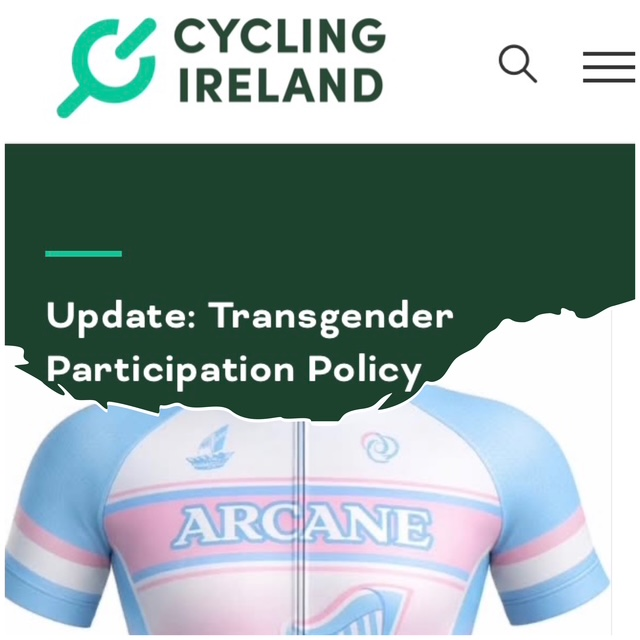
Earlier this year, Arcane Cycling Team published an open letter to Cycling Ireland about a problem that should not still exist in 2026.
Right now, people registering with Cycling Ireland are still effectively forced into a binary gender system that does not reflect the reality of many cyclists’ lives. For non-binary people, and for some intersex people, the message is simple. Misidentify yourself or remain excluded.
Not excluded from Olympic pathways or elite international racing. Excluded from participation itself. From club membership. From insurance. From leisure cycling. From simply getting on a bike and being part of the cycling community.
Despite how often these conversations get dragged into culture war narratives online. Why should somebody have to lie about who they are in order to access a non-competitive sports membership?
Since publishing the letter, Arcane Cycling Team and Queer Bike Rides Cork met directly with Louise Burke, Cycling Ireland’s Chief Commercial and Operations Officer. To her credit, the meeting was constructive and far more honest than many conversations governing bodies have historically been willing to have.
Louise Burke openly acknowledged that people should not have to misgender themselves in order to access participation and membership opportunities. More importantly, there was acknowledgement that much of this appears to be a systems and governance issue rather than an unavoidable sporting regulation issue.
Sporting organisations have spent years hiding behind international federations whenever inclusion is raised. UCI rules. International regulations. Competition structures. But the overwhelming majority of cyclists in Ireland are not elite athletes chasing ranking points or Olympic qualification. They are ordinary people cycling recreationally, socially, locally, or simply for enjoyment and wellbeing.
Yet participation structures continue inheriting restrictive binary systems designed around elite competition models. This conversation is also happening in a very different political and legal environment than it was even a few years ago. International human rights bodies are increasingly recognising that blanket exclusionary approaches towards trans and intersex people in sport are discriminatory and harmful. The Council of Europe has explicitly called for intersex people to be able to participate in sport without unnecessary medical scrutiny or discriminatory requirements. Across Europe, inclusion in participation sport is increasingly being understood as a human rights issue rather than a culture war talking point.
Irish sporting bodies cannot pretend that wider context does not exist. One of the most striking aspects of the meeting was hearing LGBTQ+ cyclists describe the culture surrounding parts of Irish cycling, particularly men’s racing spaces. The word “toxic” came up – years of normalised homophobia, exclusion, identity policing, and hostility towards inclusion initiatives.
Sport in Ireland still struggles profoundly with masculinity and conformity. Cycling is not unique in that regard, but it cannot continue pretending participation barriers are only about funding, road safety, or infrastructure.
Arcane Cycling Team is not the only group raising these concerns. LGBTQ+ cyclists and organisers have been pushing on these issues for years. Some were ignored. Some were quietly redirected internally. Some reached institutional dead ends.
Inclusion is not measured by rainbow branding during Pride month. Inclusion is measured by whether organisations are willing to change structures that actively exclude people.
And right now, Cycling Ireland still operates a system where some people effectively become invisible unless they are willing to misidentify themselves.
Cycling Ireland has now indicated that membership systems are under review and that changes may be introduced ahead of the next membership cycle. Potential options discussed included more inclusive gender categories and future stakeholder engagement around LGBTQ+ participation and inclusion.
Those developments are positive. But communities who have experienced exclusion for years are also right to remain cautious. Good intentions are not structural reform. A constructive meeting does not mean implementation.
What matters now is whether meaningful change actually happens. At minimum, Cycling Ireland should introduce inclusive gender options for non-competitive memberships immediately. Participation-level membership should be separated from unnecessary elite competition restrictions. Trans, intersex, and non-binary cyclists should be directly involved in policy development rather than treated as external problems to manage. Inclusion policies should be grounded in human rights standards rather than political panic or institutional convenience.
Because ultimately this is about whether sport actually belongs to everyone or only to the people institutions already know how to accommodate. For the first time in a long time, it feels like Cycling Ireland may genuinely be listening. But listening is only the beginning.
Arcane Cycling Team will continue pushing for meaningful inclusion because nobody should lose to access sport.
And in 2026, Irish cycling should be capable of understanding something that basic.
Related Reading
- Gender, Membership, and Access: Where We Are with Cycling Ireland
- Open Letter from Arcane Cycling Team Regarding Gender Options on the Cycling Ireland Membership Portal
- Cycling Equality Policy
- Ireland’s First Intersex Cycling Champion
- They Are Testing Women Again