
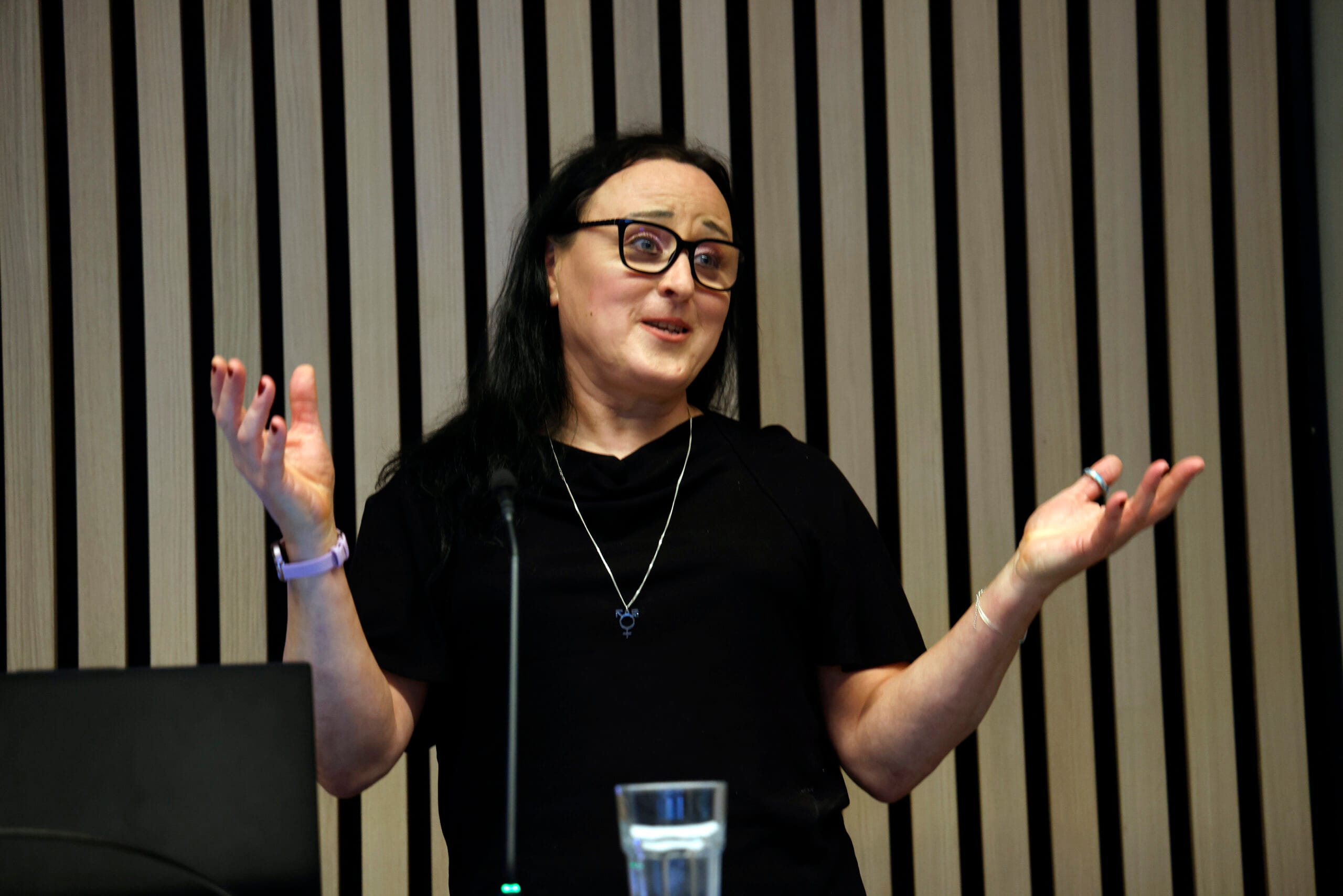
On Friday (June 12), I had the privilege of speaking at LGBT Ireland’s fifth annual Pride Healthcare Conference, Silent Letters: Addressing Invisibility in LGBTQIA+ Health and Social Care, hosted in partnership with the Royal College of Surgeons in Ireland (RCSI).
The conference brought together healthcare professionals, researchers, social care workers, community organisations, advocates and educators to examine the people and experiences that often remain overlooked within healthcare systems. The programme included sessions on queer women’s health, asexuality, workforce development, intimate partner abuse and, for the first time, a dedicated presentation on intersex healthcare and human rights.
I was invited to speak on behalf of Intersex Ireland. The RCSI is one of Ireland’s most important medical institutions, speaking directly to a room full of healthcare professionals about intersex experiences felt significant.
I opened my talk with a simple observation. Every person in that room knew what the word intersex meant. That alone makes them unusual. Most people in Ireland still do not know what intersex means. Many politicians do not. Many teachers do not. Even today, many healthcare professionals receive little or no meaningful education on variations of sex characteristics.
Yet despite repeated recommendations from the United Nations, the Council of Europe, the European Parliament and numerous human rights organisations, intersex people remain one of the least understood populations in Irish public life. Not because our issues are particularly complicated. But because our existence challenges assumptions that many institutions still find uncomfortable.
Throughout the presentation, I spoke about the long history of secrecy surrounding intersex lives. I spoke about growing up without language to describe experiences that never seemed to fit neatly into the categories society expected. I spoke about medical records withheld from patients, childhood interventions carried out without consent, and generations of intersex people who were taught that silence was preferable to honesty.
I also spoke about what happens afterwards. One of the strongest themes emerging from contemporary intersex research, including the work of Dr Adeline Berry and others, is that intersex healthcare is not simply a childhood issue. Decisions made in infancy can shape somebody’s relationship with healthcare, mental health, intimacy, trust and identity decades later. The consequences do not end when somebody leaves a paediatric clinic. For many people, that is where the real struggle begins.
One point seemed to resonate strongly with the audience. Healthcare systems often speak about intersex people as though the debate is historical. As though the difficult conversations belong to previous generations. Yet earlier this year, Intersex Ireland sat across the table from healthcare professionals responsible for intersex care in Ireland. Concerns that intersex organisations have been raising internationally for decades were once again dismissed as things that no longer happen. At the same time, people continue to contact Intersex Ireland describing those exact experiences.
One of the recurring frustrations of intersex advocacy is being told that the problem has already been solved while people are still living with its consequences. The conference theme, Silent Letters, could not have been more appropriate.
Intersex people have never been silent. We have spoken to governments, doctors, researchers, journalists and human rights bodies. We have spoken to the United Nations. We have spoken to anyone willing to listen. The real question has never been why intersex people are silent. The real question is why so few people have been listening.
What encouraged me most about the day was the quality of engagement afterwards. The questions were thoughtful. The conversations were respectful. People wanted to know how healthcare could do better, how services could become more inclusive, and how professionals could better support intersex people across the lifespan.
I had arrived with a carefully prepared script. I left having delivered something quite different. Within a few minutes it became obvious that the room did not need another lecture. The audience was engaged, curious and willing to listen. Instead of reading what I had written, I found myself following the mood of the room and speaking far more openly than I had planned. I talked about isolation, secrecy, medicalisation, trust and the lifelong consequences of decisions made for intersex people without their consent. Afterwards, the feedback was overwhelmingly positive. Several people specifically mentioned that the more personal sections had stayed with them long after the statistics and policy recommendations. Research matters. Evidence matters. But sometimes the most powerful thing an advocate can do is stop presenting a case study and start speaking as a human being. On this occasion, going off script turned out to be the right call.
Real change rarely begins with legislation. More often, it begins when somebody hears a story they had never heard before and realises that an entire group of people has been missing from the conversation.
My thanks go to James O’Hagan and the team at LGBT Ireland, RCSI, the conference organisers, fellow speakers and everyone who attended. Intersex Ireland remains a small volunteer-led organisation, but on Friday our community had a voice in one of Ireland’s most important healthcare spaces. For a movement that has spent decades being spoken about rather than spoken with, that matters.
Intersex people have never been silent. We have been here all along.
The challenge now is whether our institutions are finally ready to listen.
Further Reading:
- Intersex Healthcare & Human Rights RCSI 2026
- When Sorcha Spoke to the U.S. Special Envoy Jessica Stern
- We Were Never Meant to Be Invisible: Reflections from Bread and Roses 2026
- Rights Without Roots:
- Speaking at the Intersex Conference Athens
- Ireland Under Scrutiny: ECRI and the Fight for Trans & Intersex Rights
- Sorcha Rosa Speaking at ILGA Europe 2025
- Beyond The Binary: