
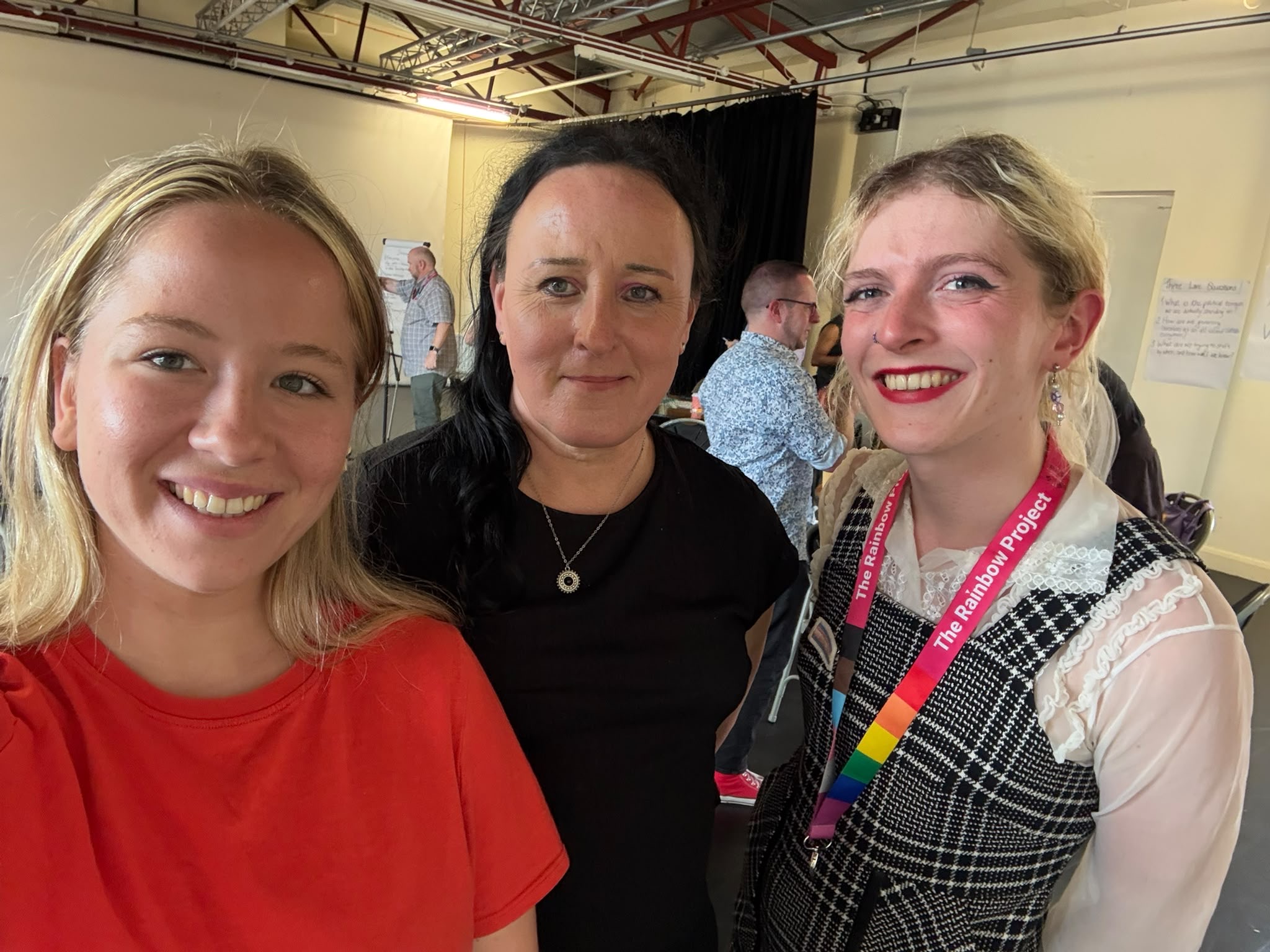
On 11 and 12 August 2026, I attended the All-Island LGBTQIA+ Forum in Derry, hosted by LGBT Ireland and The Rainbow Project. The Forum was facilitated by Ruth Baldacchino, with Tim Hanley and Alexa Moore putting a considerable amount of work into organising and supporting the two days.
I attended representing Intersex Ireland. The Forum brought together people from organisations and different parts of the LGBTQIA+ movement across the island to look at how we work together, where the gaps are, who is currently missing from these conversations and what practical structures are needed if an all-island approach is going to work.
A lot of the discussion centred on a basic question: who is actually part of the LGBTQIA+ movement? Being all-island cannot simply mean having organisations from Northern Ireland and the Republic represented at the same meeting. There are practical barriers determining who can participate, including employment, income, caring responsibilities, disability and accessibility, rural isolation, immigration status and the ability to travel across the border.
The border itself came up repeatedly. For many of us, travelling between Dublin, Belfast or Derry is relatively straightforward. That is not true for everybody. Asylum seekers and some migrants can face very different circumstances. The discussion challenged us not to assume that everyone participating in an all-island movement has the same freedom of movement, financial resources or personal circumstances.
The political and legal conditions facing trans people in Northern Ireland could also change significantly if approaches based on the EHRC’s new guidance in Great Britain are adopted there. The EHRC’s revised statutory code, which came into force in Great Britain on 5 August 2026, follows the For Women Scotland judgment and treats sex for Equality Act purposes as biological sex, with significant consequences for trans people’s access to single-sex services and facilities. Northern Ireland is legally different: the Equality Act 2010 does not generally apply there, and the Equality Commission for Northern Ireland has stressed that Northern Ireland has its own equality legislation and that questions arising from the judgment still require legal clarity. But if comparable rules are ultimately adopted in the North, trans people could find everyday access to toilets, changing facilities, healthcare and other sex-segregated services substantially more restricted. That would create an extraordinary situation on this island where a trans person could cross the border and encounter a materially different set of rules governing something as basic as which public facilities they can safely use. It is another reason why an all-island LGBTQIA+ movement needs practical North-South cooperation now, rather than waiting until those differences become entrenched.
There was also discussion about the difference between people employed within LGBTQIA+ organisations and those doing the same broad work voluntarily. Some organisations have several paid staff, while smaller groups can depend almost completely on volunteers. That affects who can attend meetings, respond to consultations, undertake follow-up work and maintain relationships with other organisations.
This is particularly relevant to smaller organisations such as Intersex Ireland. Being included in a Forum is important, but inclusion has to recognise differences in capacity. An organisation with paid staff cannot be expected to participate on exactly the same basis as a volunteer-led organisation without funding. If that difference is ignored, larger organisations will inevitably have greater capacity to shape discussions simply because they have more people and more paid time available.
One of the exercises examined four practical questions: who does the work, who absorbs backlash or harm, who gets named, funded or invited, and who decides what matters. These produced discussions about paid and unpaid work, organisational responsibility, follow-up, funding, decision-making and the unequal risks experienced by different communities.
Racialised communities, sex workers and people marginalised within LGBTQIA+ communities were specifically discussed in relation to risk. An organisation may have the resources and institutional protection to campaign publicly on an issue while individuals from the community concerned experience the consequences much more directly. That needs to be considered when campaigns and priorities are being developed.
The question of who is invited was also examined practically. Trans people, young people, sex workers, rural LGBTQIA+ people, people living with HIV, Travellers, refugees and migrants were among the communities identified in the discussions. There was also recognition that simply identifying a missing community and inviting somebody to the next meeting is not necessarily meaningful inclusion.
One of the questions put to us was: what relationships need to exist before inviting somebody? Smaller and marginalised communities cannot simply be contacted when an organisation needs somebody for a consultation, panel or funding application. Relationships need to be built between meetings and maintained over time.
The same applies to lived experience. Participants were explicitly told that they could contribute by speaking, writing, drawing or reflecting, or choose not to contribute to a particular discussion. People could leave the room, move around or take care of themselves without having to explain why. Importantly, nobody was expected to disclose personal experiences in order to participate.
That connected with another question raised during the Forum: when does solidarity become extractive? There is a practical difference between working with a community and repeatedly asking members of that community to provide their experiences. If organisations want expertise from people who are routinely excluded from formal structures, we also have to consider payment, resources, continuing involvement and whether those people have any influence over what happens after their contribution has been collected.
Intersex representation is particularly relevant here. Intersex people are routinely included within LGBTQIA+ terminology, but that does not automatically translate into intersex organisations having comparable funding, staffing or influence. Being represented by a letter in LGBTQIA+ is not the same as having the infrastructure necessary to participate equally.
Another discussion looked at movement history and asked what parts of that history exist outside formal organisations. LGBTQIA+ organising has never been carried out exclusively by NGOs. Activists, informal networks, community groups, families and individuals have all contributed to building the movement. Some of that work is documented and funded. Most of it is not.
The Forum also looked directly at decision-making. We discussed the role of funded organisations, collective versus unilateral decisions, knowledge sharing between meetings, criteria for participation, funding structures and the difference between strategic and operational decisions. There was recognition that a genuinely collaborative process may be slower, but that decisions cannot simply be described as collective if only organisations with sufficient resources are consistently able to participate in making them.
We were also asked to imagine what the movement and its infrastructure could look like in 2035. The ideas generated were quite practical. They included easier access to healthcare, free HRT, improved mental-health services, LGBTQIA+ centres or regional hubs where people could access healthcare and other services, better funding for LGBTQIA+ organisations, greater diversity within those organisations, unionised sex-work organising, stronger migrant and sex-worker organisations, paid work for queer people of colour and stronger cross-movement solidarity.
There were also broader political ambitions, including removing barriers created by the border, developing a Shared Island approach, citizens’ forums with meaningful decision-making powers and considering how LGBTQIA+ equality fits into future constitutional arrangements.
The discussion did not remain entirely at the level of identifying problems. Practical work was proposed around movement infrastructure, mapping organisations and expertise, knowledge sharing, accessible communications, identifying communities that are currently poorly connected to the Forum and gathering better information about participation.
Trans justice was identified as an area where peer organisations and expertise could be mapped so that knowledge can be shared and gaps identified. Movement infrastructure was discussed in terms of producing identifiable outputs and tracking what happens after meetings. Borders, belonging and alliances were considered as an ongoing area of work between Forums rather than something that could be resolved during a single discussion.
There was also discussion about expanding participation and mapping communities that may currently be unknown or poorly connected to established organisations. Surveys and other methods of gathering information were suggested, alongside improving accessible communication so that participation does not depend on already being part of the professional LGBTQIA+ network.
The most significant developments is that the All-Island LGBTQIA+ Forum has made a considerable move forward in communication between organisations and activists across the island. There is greater recognition of the need to include smaller organisations and groups and of the practical difficulties those groups face in participating on equal terms with larger, funded organisations.
There have also been steps towards practical working connections between organisations North and South. That is more useful than simply agreeing that greater cooperation would be desirable. People are beginning to identify who has particular expertise, where gaps exist, what information needs to be shared and what can actually be worked on together between meetings.
The next Forum provides a useful point of accountability. One of the questions explicitly asked during these discussions was what responsibility this Forum has before the next Forum in November. The value of an all-island network will ultimately be measured less by what is said during two days in a room and more by what happens in the months between those meetings.
There is still a significant amount of work to do. There are communities that remain poorly represented. There are major differences in resources between organisations. There are practical North-South barriers that cannot be removed simply by describing ourselves as an all-island movement. There are also questions about funding, representation, accountability and who ultimately has the capacity to influence priorities.
One of the things I kept returning to during the Forum was the assumptions we make when we talk about an LGBTQIA+ movement that represents all of us. We assume that because people are present, everyone is represented; that belonging, citizenship, status and safety mean roughly the same thing to everyone; that the mechanisms of the state operate equally for all of us; and that the law protects us equally. None of those assumptions are true. Crossing the border can be almost meaningless for one person and carry significant legal or personal risk for another. The same inequalities exist within our own movement. Time, money, employment, organisational status and confidence all affect who can participate and who feels safe enough to speak. We also have to acknowledge that prejudice exists within LGBTQIA+ movements themselves. At a time when anti-trans narratives originating in Britain and the United States are increasingly influencing political and public debate here, and when parts of the political left appear increasingly cautious about unequivocally defending trans rights, building an all-island movement requires us to understand these differences rather than assuming that any of us can speak for everyone.
But the Forum in Derry represented progress. Communication has improved, smaller organisations and less represented communities are being considered more deliberately, and practical relationships are developing across the island.
For an all-island LGBTQIA+ movement to work, those connections have to continue beyond Derry. The task now is to turn the conversations, contacts and proposed structures from these two days into practical cooperation before we meet again in November.
Further Reading:
- Ireland May Finally Recognise Non-Binary and Intersex People
- Ten Years On – Ireland’s Gender Recognition Act Still Leaves Us Behind
- We Have Never Been Silent: Speaking on Intersex Healthcare and Human Rights at RCSI
- When Ireland Spoke to the World: Meeting U.S. LGBTQI+ Envoy Jessica Stern
- We Were Never Meant to Be Invisible: Reflections from Bread and Roses 2026
- Why Should Non-Binary Cyclists Have to Lie to Participate?
- Anti-Fascism Must Include Bodily Autonomy
- Open letter from Arcane Cycling Team regarding gender options on the Cycling Ireland membership portal
- Rights Without Routes
- Athens, Boobs, and the Future of Intersex Rights
- Ireland Under Scrutiny: ECRI and the Fight for Trans & Intersex Rights
- Ireland’s First Intersex Cycling Champion
Leave a Reply