
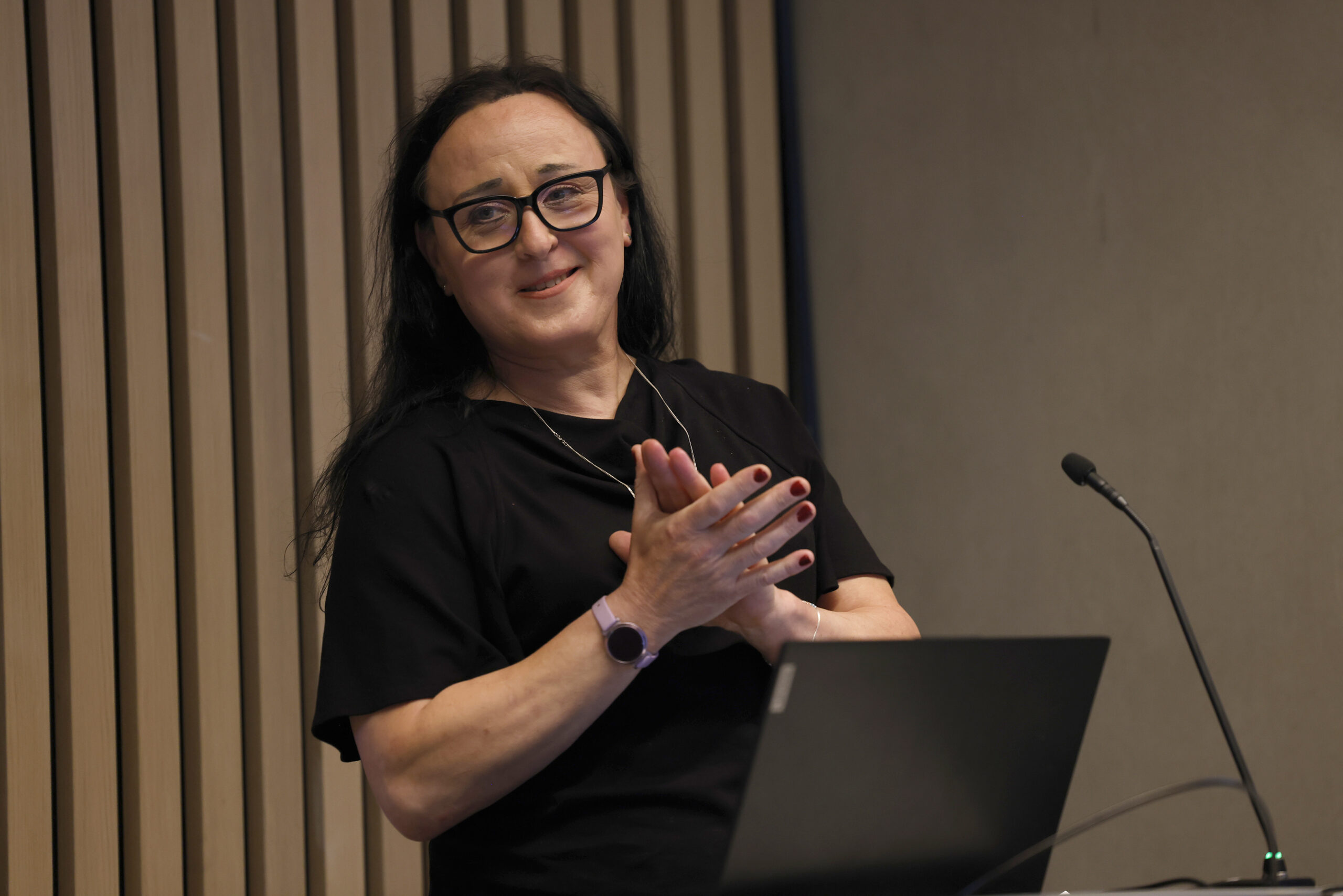
Recently I have had to step back from some of my usual public-facing advocacy, events and writing. But the work has not stopped, and over the coming months I will gradually be getting back into the room.
Beginning this week, I have a series of events coming up that touch on many of the areas I have spent years working on: intersex representation, LGBTQIA+ organising, socialist feminism, economic inequality, anti-fascism, sport, ageing, healthcare and bodily autonomy. They are very different events, from an all-island LGBTQIA+ organising forum in Derry and a socialist summer school in Glendalough, to a formal debate on capitalism and feminism at UCD and two discussions about what ageing well should mean for LGBTQI+ people.
As usual, all events I speak at or attend have a common thread. Who gets included, gets heard, performs the work, and who has power? And how do we move beyond simply talking about equality towards actually changing the structures that produce inequality?
My first stop is Derry 11–12 August: All-Island LGBTQIA+ Forum, Derry. On Tuesday 11 and Wednesday 12 August, I will be at the 2026 All-Island LGBTQIA+ Forum, organised by LGBT Ireland and The Rainbow Project and facilitated by Ruth Baldacchino. This isn’t being organised as a conventional conference. There will not be a succession of panels and long speeches. Instead, it is intended as a working space using facilitated discussion, small-group work, mapping, reflection and Strategy Labs.
The Forum builds on previous all-island gatherings that I have been invited to, and is attempting to create something more strategic: a space where LGBTQIA+ activists, organisers, community groups and organisations can develop a shared analysis of the conditions in which we are working and consider what stronger all-island movement infrastructure might actually look like.
Conditions across Ireland and the North of Ireland are difficult right now – we are dealing with organised anti-trans and anti-gender mobilisation, disinformation, overstretched services, under-resourced community organisations and unequal access to rights and care. Those pressures are also shaped by class, geography, race, migration status, disability, gender, age and proximity to political and institutional power.
One thing I particularly appreciate about the Forum documentation is its willingness to acknowledge who is not adequately represented. The organisers explicitly recognise that the gathering does not yet reflect the full breadth of LGBTQIA+ communities across the island. Among the groups identified as absent or only partially represented are Traveller and Roma communities, migrants and people seeking international protection, Black people and people of colour, disabled and neurodivergent LGBTQIA+ people, rural and border organisers, sex worker-led organising, volunteer-led groups and intersex communities.
Tuesday focuses on borders, belonging and shared movement responsibility. Wednesday moves into an assessment of what has changed since the previous Derry gathering, followed by discussions about governance and invisible labour, imagining what a flourishing all-island LGBTQIA+ movement could look like by 2035, and developing practical strategies before the next Forum.
The discussion about governance and invisible labour particularly interests me. Small and volunteer-led organisations are frequently expected to supply expertise, representation and lived experience to much larger organisations without anything approaching the same funding, staffing or institutional capacity. The people doing that work can become simultaneously essential to a movement and almost invisible within its infrastructure. The Forum takes place at The Rainbow Project’s Foyle Office at Waterloo House on Magazine Street.
There will not be much time between events, 13–16 August: Solidarity Summer School, Glendalough. The morning after the All-Island Forum finishes, I will be heading south to Glendalough in County Wicklow for Solidarity Summer School 2026, running from Thursday 13 to Sunday 16 August at Glendalough Youth Hostel. It is a very different setting, but politically there is an obvious connection.
Over four days, the Summer School brings together socialist political education, history and contemporary campaigning, with discussions spanning capitalism, climate change, racism, fascism, imperialism, revolution, feminism, trans liberation, disability, artificial intelligence and resistance through sport. Thursday begins with sessions on data centres, degrowth and climate change, what anti-racism means and why it means anti-capitalism, and sport and resistance, including the strategy for the Stop the Game campaign. That evening marks 90 years since the Spanish Revolution with A las barricadas.
Friday moves between revolutionary history and some distinctly contemporary ideological battles. The morning programme includes a Trotskyist understanding of the Cuban Revolution; postmodernism versus dialectical materialism in an era of conspiracy capitalism; prisoners’ resistance to British repression from the 1976 Maze prison blanket protests through to the hunger strikes; and resisting the normalisation of Islamophobia and anti-Arab racism.
The afternoon moves from Palestinian writer and revolutionary Ghassan Kanafani and Brazilian trade unionist and environmental activist Chico Mendes to discussions about campism, permanent revolution and the rise of China as a new imperialist power. Friday evening returns to the fundamentals with “Socialism 101: Ideas to Change the World, and Why You Should Join Solidarity.”
Saturday morning contains several discussions that particularly interest me. There is a session on the trans liberation movement in Latin America, alongside one looking at the revolutionary lives of Afeni and Assata Shakur, marking 60 years since the foundation of the Black Panther Party. Other discussions examine the political economy of the classical fascist regimes and the rivalry between the Gulf monarchies of the UAE and Saudi Arabia.
Saturday afternoon is free before the evening plenary, “The Bolsheviks: Why We Take Inspiration from the Russian Revolution.” Then Sunday brings the discussion firmly into some of the political questions confronting us now. Will artificial intelligence replace human labour? What should a programme for change around disability, the state and the family look like? What kind of struggle is needed to defend Gaeltacht areas? And why have fascists become so fascinated with the idea of the “trad wife”?
That final question is the subject of “Why Fascists Love Trad Wives: Social Reproduction Theory and its Relevance Today.” From a socialist feminist perspective, it is a particularly interesting subject. The renewed idealisation of women as wives, mothers, carers and domestic workers cannot be separated from questions about who performs reproductive labour, who benefits from it and why reactionary political movements place such importance on restoring rigid gender and family roles.
The Summer School concludes on Sunday afternoon with “Solidarity in Struggle: Lessons from the Past to Guide the Future.” For me, political education matters because activism can very easily become entirely reactive. We spend enormous amounts of time responding to the latest attack, the latest manufactured controversy, the latest political manoeuvre or another attempt to roll back rights. Without a broader political analysis, it is possible to spend your entire life defending yesterday’s victories without ever asking why the same inequalities keep reproducing themselves.
Socialist politics requires us to make those connections. Trans liberation is connected to bodily autonomy. Feminism is connected to reproductive and unpaid labour. Racism is connected to economic power and imperialism. Climate politics is connected to who owns resources and determines how they are used. Sport can become another terrain upon which wider political struggles are fought.
So I will spend Tuesday and Wednesday in Derry thinking about the future of the all-island LGBTQIA+ movement, and Thursday through Sunday in Glendalough discussing the wider political and economic structures within which those struggles take place.
It is going to be quite a week. After that burst of activity in August, my next major public event will be on Thursday 22 October at University College Dublin – 22 October: Capitalism and Feminism at UCD
I have been invited by UCD’s Literary & Historical Society to speak in a debate as part of its 172nd Session. The motion is: “This House Believes That Capitalism is Incompatible with Feminism.” I will be speaking for the proposition. The debate takes place at 6:30pm in the Fitzgerald Debating Chamber in the UCD Student Centre.
There will be three speakers on each side, combining invited guests and student speakers. Each speaker gets seven minutes, with the opposing side able to offer Points of Information during speeches. At the end of the debate, the audience decides whether the motion has been carried. There is quite a lot I want to fit into seven minutes – the relationship between capitalism and feminism cannot simply be measured by whether individual women are now able to become wealthy, run companies or occupy positions previously reserved almost entirely for men. We have to look underneath that success Who provides care and who occupies many of the lowest-paid jobs? Economic dependency restrict women’s ability to exercise genuine freedom. What happens when women’s bodies, sexuality and identities become commodities? And when we celebrate advances in women’s rights, which women actually have the economic resources to exercise those rights? Healthcare and bodily autonomy belong in that discussion too.
A right that exists on paper means considerably less when someone’s ability to exercise it depends upon their income, housing, employment, access to healthcare or ability to pay for legal assistance. My politics on this are socialist feminist. I do not believe women’s liberation can be measured simply by how many women reach corporate boardrooms while millions of other women continue to provide the poorly paid and unpaid labour upon which those boardrooms ultimately depend.
I was also interested to discover why the L&H approached me. Their Debates Convenor, Laura McMenamin, had encountered my work and writing through Instagram, particularly my participation in the International Women’s Day anti-fascist teach-in and my advocacy around transgender inclusion in sport. That intersection between feminism, class, bodily autonomy and the struggles of marginalised communities is what I intend to bring into the chamber.
Six days later, on Wednesday 28 October, I will be at the Carmichael Centre on North Brunswick Street in Dublin for a very different discussion -28 October: LGBTQI+ Inclusive Residential Care
LGBT Ireland, Nursing Homes Ireland and the University of Kent are bringing community members together for a World Café event on inclusive residential care for the LGBTQI+ community. The workshop will contribute to the development of a free resource for health and social care staff, looking at issues including moving into residential care, maintaining connections with LGBTQI+ communities, inclusive policy and training, and trans and non-binary inclusion.
This is an area of equality work that is only going to become more important. Our communities are ageing. We have spent decades fighting for LGBTQI+ people to have the right to live openly. We now need to think seriously about what happens when those same people become older and potentially dependent upon residential or nursing care.
Can someone who has lived openly for decades continue to do so? Will staff understand their history? Can they remain connected to their community? Will partners and chosen families be recognised? Will policies designed to be inclusive actually work when confronted with someone’s real life? And, once again, will intersex people be recognised at all? I have offered to bring an intersex perspective to that discussion.
For intersex people, ageing and residential care inevitably intersect with healthcare and bodily autonomy. Older intersex people may have lived through medical systems in which secrecy, stigma, pathologisation and interventions intended to make bodies conform to conventional definitions of male or female were accepted clinical practice.
Those histories do not disappear when somebody reaches old age. Inclusive residential care therefore has to mean considerably more than putting a rainbow sticker on the door. It has to mean understanding the people who will eventually walk through it.
The following Wednesday, 4 November, I will be participating in another World Café organised by LGBT Ireland, this time in partnership with Trinity College Dublin’s School of Nursing & Midwifery – 4 November: Setting Research Priorities for LGBTQI+ Ageing
The Research Priority Scoping Project will bring together LGBTQI+ community members and stakeholders from services associated with positive ageing to identify gaps in existing knowledge and help determine priorities for future research into ageing within our communities. Again, I intend to bring an intersex perspective. Research creates the evidence eventually used by policymakers, healthcare providers, advocacy organisations and funding bodies. If a population is missing from that evidence, it becomes considerably easier for its needs to disappear from policy as well.
Looking at these events together, I am struck by how different they are. I will be in Derry discussing the infrastructure and future of LGBTQIA+ organising across the island.
Then I will be in Glendalough discussing socialism, feminism, fascism, racism, imperialism, climate change, trans liberation and political resistance.
In October, I will stand in a university debating chamber and argue that capitalism is incompatible with feminism.
Then the conversation moves towards ageing: first asking what genuinely inclusive residential care should look like, and then asking what researchers need to understand if future policy and services are going to serve LGBTQI+ people properly.
For intersex people in particular, simply being somewhere matters. We cannot influence conversations from which we are absent. After a quieter period personally, I am looking forward to being back in those rooms.
Where I’ll Be
11–12 August 2026
2026 All-Island LGBTQIA+ Forum
The Rainbow Project Foyle Office, Waterloo House, Magazine Street, Derry/L’Derry
Organised by LGBT Ireland and The Rainbow Project, facilitated by Ruth Baldacchino.
13–16 August 2026
Solidarity Summer School 2026
Glendalough Youth Hostel, The Lodge, Sevenchurches, Glendalough, Co. Wicklow.
22 October 2026, 6:30pm
This House Believes That Capitalism is Incompatible with Feminism
Literary & Historical Society, University College Dublin
Fitzgerald Debating Chamber, UCD Student Centre
Speaking for the proposition.
28 October 2026, 10am–2pm
Co-Creation Workshop: Inclusive Residential Care for the LGBTQI+ Community
LGBT Ireland, Nursing Homes Ireland and the University of Kent
Carmichael Centre, North Brunswick Street, Dublin 1.
4 November 2026, 10am–2pm
Research Priority Scoping Project: LGBTQI+ Ageing
LGBT Ireland and Trinity College Dublin School of Nursing & Midwifery
Dublin city centre, venue to be confirmed.
About Sorcha Rosa
Sorcha Rosa is an Irish intersex and trans activist, socialist feminist, writer and former elite cyclist. Her advocacy focuses on intersex rights and visibility, bodily autonomy, LGBTQIA+ equality, trans inclusion in sport, healthcare and the relationship between gender equality, class and economic power. She is Secretary of Intersex Ireland and has contributed to national and European discussions on intersex rights, healthcare, sport and legal recognition.
Her work is grounded in a socialist feminist approach that connects struggles for intersex and trans liberation with wider questions of economic inequality, reproductive and unpaid labour, anti-racism and anti-fascism. Through public speaking, political organising and her writing at Simply Sorcha, she argues for intersex people to be active participants in the movements and institutions making decisions about their lives, rather than simply being represented by the “I” in LGBTQIA+.
Further Reading:
- Ireland May Finally Recognise Non-Binary and Intersex People
- Ten Years On – Ireland’s Gender Recognition Act Still Leaves Us Behind
- We Have Never Been Silent: Speaking on Intersex Healthcare and Human Rights at RCSI
- When Ireland Spoke to the World: Meeting U.S. LGBTQI+ Envoy Jessica Stern
- We Were Never Meant to Be Invisible: Reflections from Bread and Roses 2026
- Why Should Non-Binary Cyclists Have to Lie to Participate?
- Anti-Fascism Must Include Bodily Autonomy
- Open letter from Arcane Cycling Team regarding gender options on the Cycling Ireland membership portal
- Rights Without Routes
- Athens, Boobs, and the Future of Intersex Rights
- Ireland Under Scrutiny: ECRI and the Fight for Trans & Intersex Rights
- Ireland’s First Intersex Cycling Champion
Leave a Reply