
Eleven years ago, Ireland passed the Gender Recognition Act. It was a historic piece of legislation, won through decades of activism and through the extraordinary determination of people like Dr Lydia Foy, who forced the Irish State to confront its treatment of transgender people. It was also incomplete. Like many achievements of this nature, it left many people behind.
Last year, marking the tenth anniversary of the Act, I wrote that the Gender Recognition Act was both a victory and a compromise. It delivered legal recognition for many transgender people while deliberately excluding others. Non-binary people were left invisible. Intersex people were left out entirely. Young people were subjected to layers of gatekeeping that exposed the limits of Ireland’s commitment to bodily autonomy and self-determination.
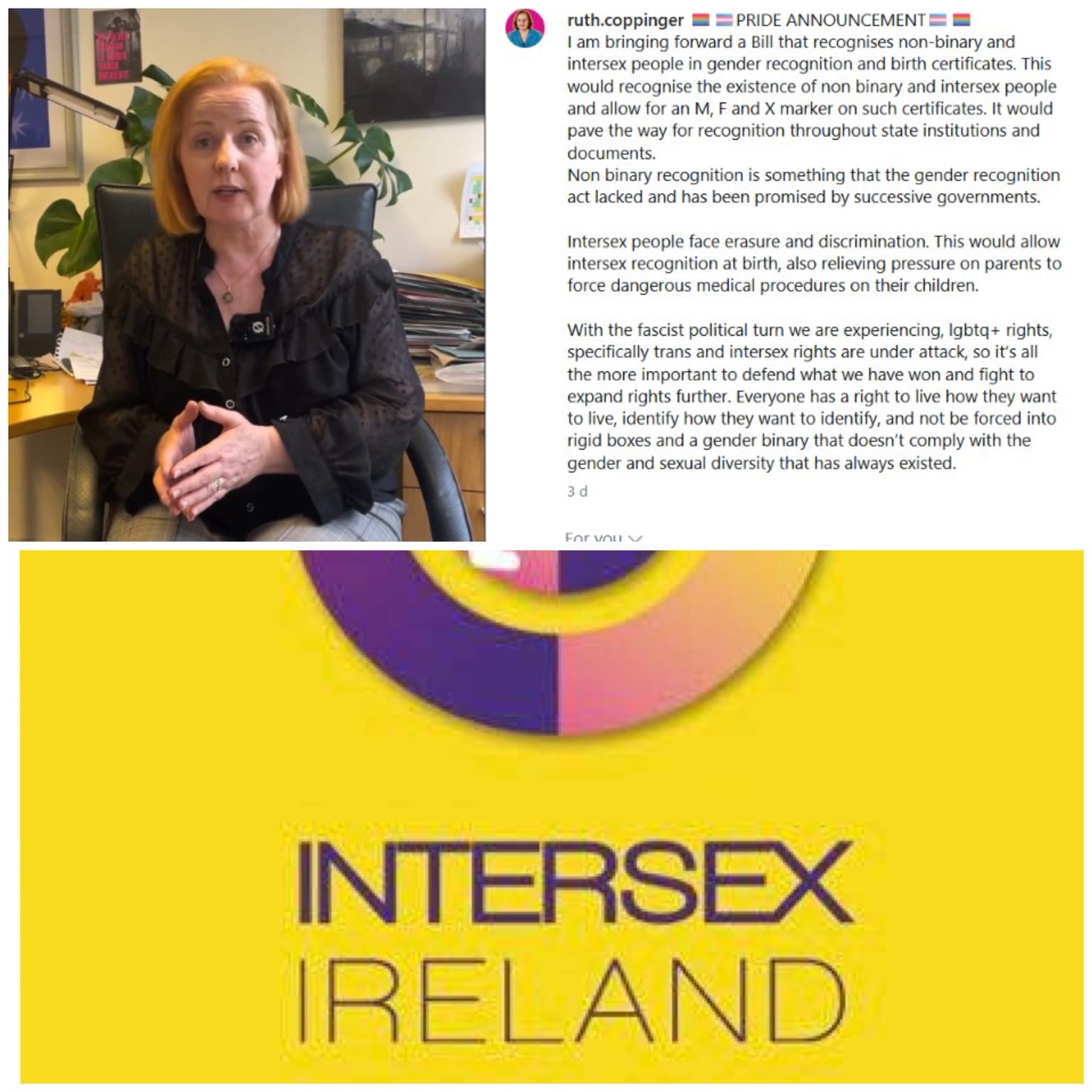
Eleven years later, Ireland may finally be taking steps to address some of those omissions. This week, Ruth Coppinger announced plans to introduce legislation that would recognise non-binary and intersex people within Irish law.
The proposed Bill would introduce an X marker, create legal recognition for non-binary identities, allow for the registration of intersex children using an X designation on birth certificates, and extend equality protections on the basis of sex characteristics.
As Secretary of Intersex Ireland, I have been involved in discussions around the Bill and had the opportunity to provide feedback during the drafting process. For that reason, I welcome this legislation.
It is not perfect, but because for the first time in over a decade, somebody is attempting to address some of the people left behind by the Gender Recognition Act.
For years, Irish governments have acknowledged the exclusion of non-binary people. Reviews have been commissioned. Reports have been written. Recommendations have been made. Promises have been broken.
Year after year, non-binary people remained legally invisible. Successive governments simply chose not to act. The same is true for intersex people.
Despite repeated recommendations from international human rights organisations, despite growing awareness across Europe and the work of organisations such as Intersex Ireland, intersex people have remained almost entirely absent from Irish law and policy.
When intersex people do appear, it is usually through a medical lens. We are discussed as conditions, clinical challenges, and rare cases – but never as citizens with rights.
Ruths Bill changes that. The inclusion of sex characteristics within equality legislation is particularly significant. For years, intersex activists across Europe have argued that discrimination protections should explicitly include sex characteristics. The language is increasingly recognised by international human rights bodies, by the Council of Europe, by ILGA-Europe and by OII Europe.
Throughout discussions with Ruth’s office, Intersex Ireland consistently raised concerns around bodily autonomy and medically unnecessary interventions on intersex children. Those concerns remain. The Bill addresses recognition and discrimination. However it does not address the issue many intersex organisations consider the most urgent human rights concern facing our community: non-consensual and irreversible medical interventions carried out before an intersex person is old enough to participate in decisions about their own body.
Healthcare is also largely absent. There is little here relating to specialist pathways, psychosocial support, adult services, oversight mechanisms, or accountability within intersex healthcare.
From the outset, Intersex Ireland understood that no single Private Members’ Bill was likely to resolve every issue facing our community. Our discussions with Ruth and her team focused on identifying reforms that were achievable while also moving Ireland closer to international human rights standards. While we would have liked to see stronger provisions relating to bodily autonomy and medically unnecessary medical interventions, we also recognise that legislation is often built in stages. Recognition, equality protections and visibility were core objectives of our engagement, and it is encouraging to see those objectives reflected in the final proposal.
The reality is that this legislation goes further than anything any Irish government has proposed for intersex people in the eleven years since the Gender Recognition Act became law.
The timing is very important, across Europe and beyond, trans, non-binary and intersex communities are increasingly being targeted by organised political movements. Hard-won rights are being challenged. Basic healthcare is being politicised. Human diversity is being reframed as an ideological threat rather than an ordinary part of society.
It is entirely appropriate that this Bill is being brought forward by Ruth Coppinger. Throughout her political career, Ruth has represented a tradition of socialist feminism that understands liberation is indivisible, and the rights of women, LGBTQIA+ people, workers, migrants and other marginalised communities are not competing causes. At a time when some have attempted to position feminism and queer liberation as opposing forces, Ruth has consistently rejected that choice. Ireland desperately needs politicians willing to defend trans, non-binary and intersex people in the face of growing hostility and imported culture wars. Feminists like Ruth Coppinger remind us that solidarity has never been more important than it is today.
Further Reading:
- Ten Years On – Ireland’s Gender Recognition Act Still Leaves Us Behind
- We Have Never Been Silent: Speaking on Intersex Healthcare and Human Rights at RCSI
- When Ireland Spoke to the World: Meeting U.S. LGBTQI+ Envoy Jessica Stern
- We Were Never Meant to Be Invisible: Reflections from Bread and Roses 2026
- Why Should Non-Binary Cyclists Have to Lie to Participate?
- Anti-Fascism Must Include Bodily Autonomy
- Open letter from Arcane Cycling Team regarding gender options on the Cycling Ireland membership portal
- Rights Without Routes
- Athens, Boobs, and the Future of Intersex Rights
- Ireland Under Scrutiny: ECRI and the Fight for Trans & Intersex Rights
- Ireland’s First Intersex Cycling Champion
About Sorcha Rosa:
Sorcha Rosa is an intersex woman, writer, activist, former elite cyclist, and Secretary of Intersex Ireland. For more than a decade she has worked across intersex, transgender and LGBTQIA+ advocacy, contributing to policy discussions in Ireland and at European level. Her work focuses on bodily autonomy, healthcare, equality, legal recognition and the lived realities of intersex people. Through Simply-Sorcha.com she combines personal experience, political analysis and advocacy, documenting both the progress made and the challenges that remain for marginalised communities in Ireland.