
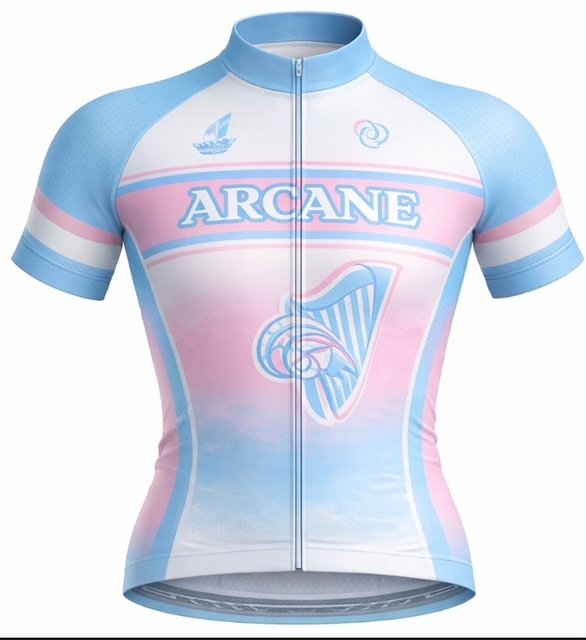
Over the past number of weeks, Arcane Cycling Team has been engaged in a public and private conversation with Cycling Ireland about gender options within its membership registration system. This post sets out, clearly and transparently, what has happened to date, why the issue matters, and what we are now waiting for.
Why we raised the issue
Arcane Cycling Team recently relaunched as a fully queer cycling club. As part of that relaunch, we have been encouraging our members to hold Cycling Ireland membership, particularly non-competitive or leisure membership, because it provides insurance, collective governance, and access to the wider cycling ecosystem.
However, the Cycling Ireland membership portal currently requires all applicants to select either “male” or “female” in order to register. For non-binary and intersex people, this requirement causes distress and creates a barrier to participation. Being required to misidentify oneself in order to access insurance and basic participation is not a neutral administrative detail; it has real consequences.
Our concern is not about competition categories, performance, or eligibility. It is about non-competitive and participatory membership, where international competition regulations should not determine whether someone can join a club, be insured, or take part in cycling safely.
The open letter
In response to concerns raised by our members and wider community, Arcane Cycling Team published an open letter calling on Cycling Ireland to:
- Introduce inclusive gender options for non-competitive membership
- Decouple leisure membership from unnecessary binary gender requirements
- Clarify how and why gender data is collected
- Engage meaningfully with trans, non-binary, and intersex communities
The letter was deliberately framed in good faith. It acknowledged regulatory constraints where they exist, but argued that administrative systems for non-competitive participation are within Cycling Ireland’s own control.
Engagement and responses
Following publication of the open letter, we contacted Cycling Ireland leadership formally and invited engagement. We also shared the letter with equality and civil liberties organisations for awareness.
We received engagement from a range of interested parties across the equality, community, and civil liberties space. These conversations have been constructive and supportive, and they reflect a broader concern about access, dignity, and participation in sport.
Initially, we received no response from Cycling Ireland. After a follow-up, we received a reply from Cycling Ireland’s Chief Commercial and Operations Officer.
Cycling Ireland’s response
Cycling Ireland’s response outlined the following position:
- That Cycling Ireland’s membership registration system is linked to UCI ID requirements
- That the UCI currently only recognises “male” and “female” gender markers
- That these structures were designed primarily for competitive regulation
- That Cycling Ireland recognises the need to better reflect inclusion at participation level
- That Cycling Ireland has begun work with Sport Ireland’s Ethics and Integrity Unit to review membership structures
- That this work is intended to take place throughout 2026, with consultation and research, with a view to changes for the following membership cycle
While we welcome the acknowledgement that current systems do not adequately reflect inclusive participation, this response does not address the practical issue facing people seeking non-competitive membership now, nor does it outline any interim measures.
It also does not engage with the specific solutions proposed in our open letter, such as alternative gender data options, opt-out mechanisms, or decoupling leisure membership from UCI-linked classifications.
Why this matters
We are aware that similar concerns have been raised in the past by other LGBTQ+ cycling groups, particularly in relation to leisure membership, without a clear outcome or timeline. This suggests that the issue is not isolated to one club, but reflects a wider structural gap.
A review process extending through 2026, without interim solutions, means that non-binary and intersex people are effectively asked to wait years to access cycling on equal terms. In the meantime, the burden of exclusion remains with those already marginalised.
Inclusion delayed is still exclusion.
What we are asking for now
Arcane Cycling Team remains committed to engaging constructively and in good faith. We are not seeking to bypass regulation or undermine sporting governance. We are asking for clarity, proportionality, and practical action in relation to non-competitive participation.
Specifically, we are seeking clarity on:
- Whether Cycling Ireland recognises scope to decouple leisure or participatory membership from UCI gender classifications, even on an interim basis
- Whether inclusive gender data options have been explored for non-competitive membership and event participation
- Whether any short-term mitigations are being considered to prevent people being required to misidentify themselves in order to access membership and insurance
- What timelines and points of contact exist for further engagement
Where we are now
We have responded to Cycling Ireland’s reply, seeking clarification on these points. At the time of writing, we are awaiting further response.
This post is not an escalation. It is a record.
Cycling Ireland has stated that cycling is open to all and that participation matters. We agree. Administrative systems should reflect that commitment in practice, not only in principle.
We remain hopeful that meaningful engagement will follow, and we will continue to update our members and community transparently as this process unfolds.
Comments
One response
The European Parliament has passed a resolution that declares that trans women are women.
The resolution was passed on 11 February ahead of the upcoming 70th session of the UN Commission on the Status of Women, an global intergovernmental body dedicated to the promotion of gender equality. The convention is due to take place in New York in March.
The council devised a list of recommendations concerning EU priorities to take to the session, which included: “emphasize the importance of the full recognition of trans women as women, noting that their inclusion is essential for the effectiveness of any gender-equality and anti-violence policies; call for recognition of and equal access for trans women to protection and support services.”
The list of recommendations also mentioned the wider LGBTQ+ community several times, and included the need to secure “sustainable funding and legal protection for feminist and LGBTIQ+ organisations”, ensure “access to gender-sensitive mental health services for young women and LGBTIQ+ people”, and prioritise “foreign, development and security policy, which is inclusive and intersectional, prioritising the needs of women and LGBTIQ+ human rights defenders”.
Transphobia has now at this point gone way overboard.