
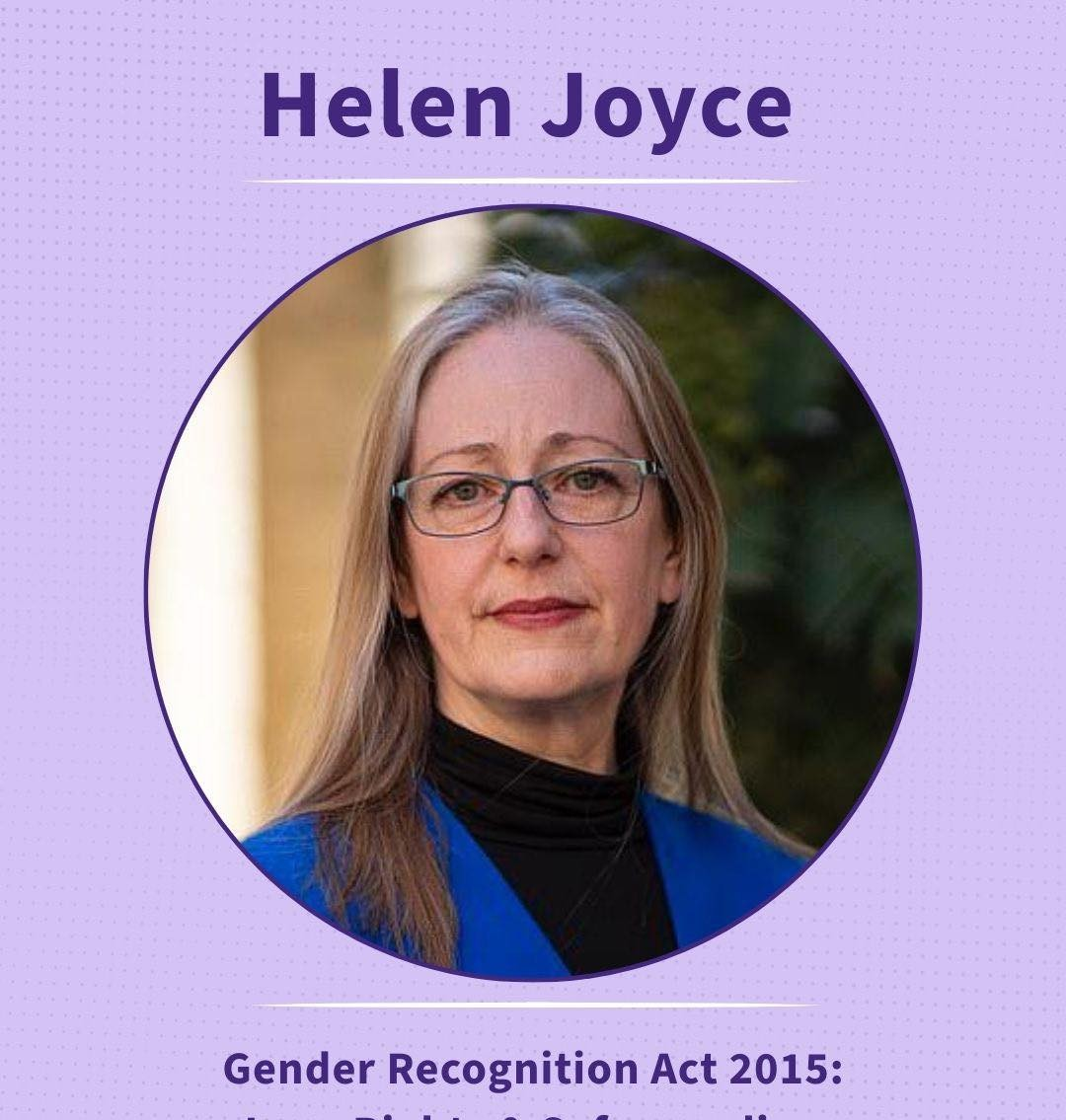
On March 7th in Dublin City Centre, a €40-a-ticket conference titled ‘Gender Recognition Act 2015: Law, Rights & Safeguarding’ is being hosted by a Facebook page called Wicklow Women 4 Women, currently sitting at 37 likes and 51 followers, featuring a predictable line-up of Helen Joyce, Stella O’Malley of Genspect, Fiona McAnena of Sex Matters, Laoise de Brún of The Countess, Senator Sharon Keogan, Ken O’Flynn TD and Austrian activist Faika El-Nagashi, among others, in what is being marketed as a women’s safeguarding event but functions in reality as a tightly networked anti-trans conference dressed up as grassroots feminism.
As we have shown in previous articles, this is a small, ideologically aligned cluster of activists and media personalities recycling British culture war narratives, repackaging them with Irish branding, and attempting to project scale through repetition and cross-promotion. When you trace the connections, the same names and the same organisations surface again and again. Genspect. Sex Matters. The Countess. Women’s Space Ireland. Gaels for Fair Play. Not All Gays. Their network is tiny, the messaging is identical.
Wicklow Women 4 Women describes itself as committed to “sex-based rights of women and children.” That phrase is a deliberate framing device imported directly from UK anti-trans lobbying groups who have spent the last five years trying to roll back legal recognition and healthcare access for trans people. Their slogan designed to imply that trans equality is in conflict with women’s safety.
Helen Joyce has built a public platform arguing that trans identities represent a social contagion. Stella O’Malley’s Genspect promotes narratives questioning gender-affirming care and legal recognition. Fiona McAnena represents Sex Matters, a UK lobbying organisation actively pursuing litigation to restrict trans inclusion in public life. Laoise de Brún’s The Countess operates within the same framework. Women’s Space Ireland, founded by Jill Nesbit, amplifies Genspect content and similar messaging. Catherine Monaghan has written within that same orbit. These are not isolated activists who just happen to share a stage. They are connected in a coherent conservative political project.
Background reading recommended for the event directs attendees to Genspect materials urging Ireland to return to reality-based legislation.
And yet they suggest that this is about dialogue. Safeguarding. Debate. Safeguarding from whom?
The Gender Recognition Act 2015 did not, as they claim dismantle our laws, or abolish safeguarding obligations. It did not create new categories. It allowed trans people to have their gender legally recognised through a democratic process supported by the Oireachtas and consistent with Ireland’s trajectory towards equality.
There is no evidence of any harm caused by that legislation (with the exception of leaving non-binary and intersex people behind). There is no data demonstrating that recognising trans people’s identities has undermined women’s safety in Ireland.
Their momentum requires numbers. Thirty-seven likes is not a movement. Fifty-one followers is not a groundswell. It is a small group with loud amplification. Our delve into the Countess, their membership and their finances showed a tiny organisation masquerading as a women’s rights group.
The inclusion of Senator Sharon Keogan (a woman who shared a picture of herself online with the rapist Conor McGregor), and Ken O’Flynn TD signals that this is not just for social media, it is an attempt to edge anti-trans framing into mainstream Irish politics. The presence of international figures like Faika El-Nagashi, whose politics have shifted sharply toward anti-trans positions in recent years, reinforces that this is part of a wider European alignment. This is how culture wars travel – through interconnected platforms and shared messaging.
These organisers do not speak for Irish women. They do not speak for ROSA. They do not speak for the National Women’s Council of Ireland. They do not speak for the mainstream women’s sector, which has consistently taken intersectional positions on equality and human rights. They do not speak for the broad coalition of feminists who understand that trans women are women, that trans men and non-binary people exist within our communities, and that feminism rooted in exclusion is not feminisim.
Ireland’s feminist movement has fought for reproductive rights, for marriage equality, for protection from gender-based violence, for economic justice. It has done so through coalition, solidarity and a clear understanding that liberation is not divisible.
The actual crises facing women in Ireland remain underfunded domestic violence services, housing, healthcare access gaps, childcare costs, poverty and rising far-right rhetoric. None of these are addressed by targeting a marginalised minority. None of them are solved by questioning trans people’s legal existence.
They can rebrand under a local name (Natural Women’s Council). They can create a new Facebook page. They can rotate speakers and refresh graphics. But when the same network appears, and the same talking points circulate, and the same organisations link back to each other through Substacks, guest posts and conference circuits, the pattern is easy to trace.
Irish feminism is bigger than they can ever achieve. We are louder than them, and braver than them. And we will not see it rewritten by a €40 culture war conference with 37 likes.
Leave a Reply