
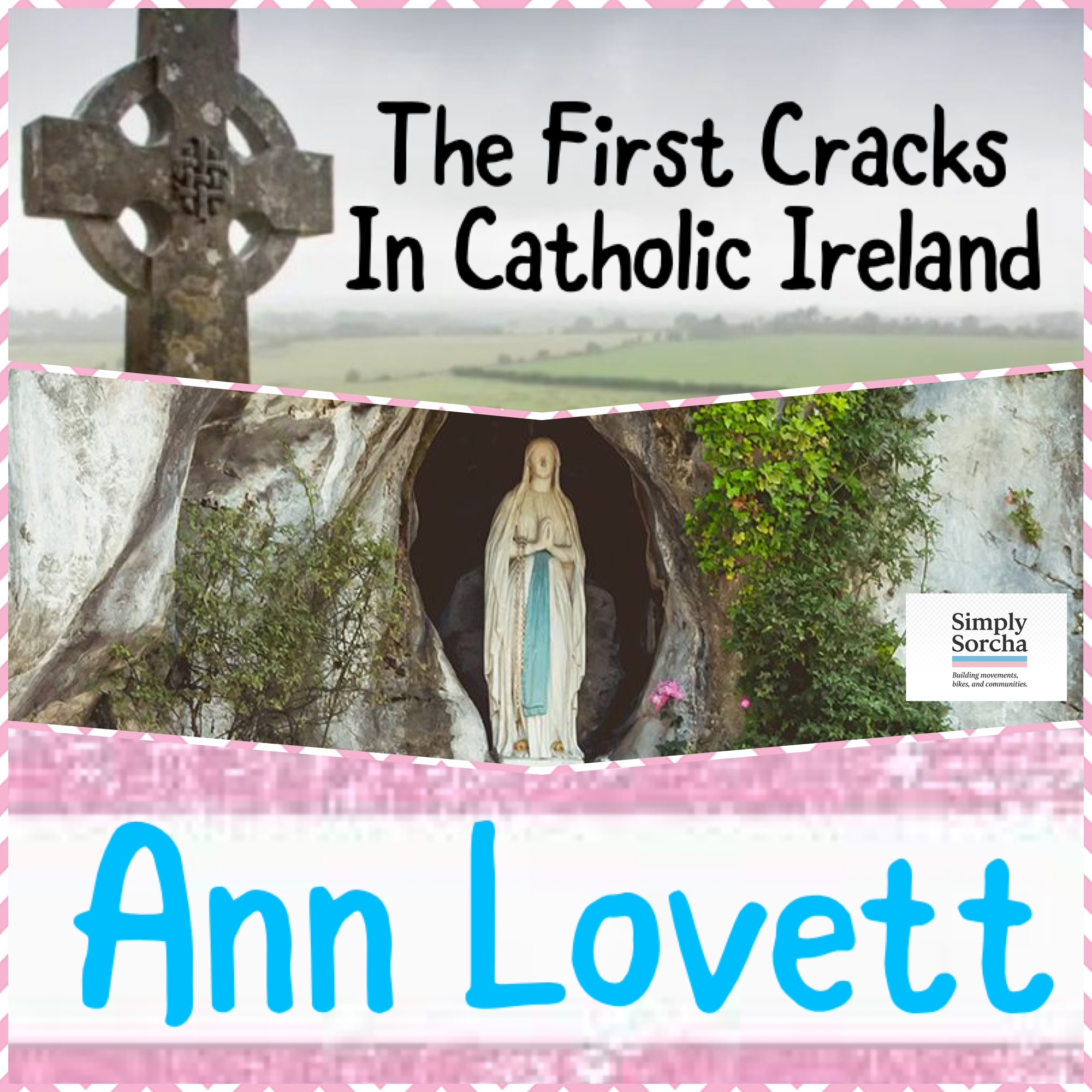
By Sorcha Rosa
There are moments in our nations story when the façade cracks, when blessed Holy Ireland splits down the centre and the truth pours out.
For my generation, that moment was 31 January 1984.
The day Ann Lovett died in the cold rain at a grotto in Granard.
I was a year younger than Ann. A teenager. A goth, a Curehead drifting between gigs and Dublin bus runs and a growing certainty that the Ireland we’d been handed was not the Ireland we were going to keep.
Ann’s death hit us hard. Not the sanitised national tragedy that the media eventually pretended it was. This was our movement. And every teenager in Ireland felt it beneath the skin.
We all talked about her. The adults didn’t. The priests didn’t. The politicians didn’t.
They covered it up, brushed it aside, muttered about immaturity, about secrecy, about “nobody knew”, as if that were even remotely believable. As if a pregnant fifteen-year-old girl in a small Irish town could ever be invisible unless people wanted her to be invisible.
We knew what had happened. Ann wasn’t a mystery to us. She was one of us.
She symbolised what we were becoming: a generation slipping out of the chokehold of Catholic Ireland, discovering our bodies, our desires, our music, our anger, our resistance. She embodied the Ireland we were trying to birth, and the Ireland that killed her was the Ireland that preferred girls like her dead rather than seen.
Ireland would rather a 15-year-old girl die alone at a grotto with her newborn baby than allow her the dignity of a life.
We carried that truth with us. When Cry Before Dawn released Girl in the Grotto, I remember the wave of emotion, a hotel ballroom in Newbridge Kildare, a teenage army roaring the chorus into the night, crying for a girl none of us had even met but all of us recognised.
Ann Lovett was the feminist she never knew she was. A martyr to a struggle she didn’t choose. A child failed by a society terrified of sexuality and women’s bodily autonomy.
The stories of abuse she suffered at home were not rare or shocking, they were our stories, it was my story. We knew those fathers. Those mothers. Those priests. Those teachers. Those small-town rumours. That suffocating patriarchal Catholicism that policed every breath we took.
Ann’s death changed us. Turned something over in us. And we would never go back.
When Gay Byrne tossed aside the newspaper headline – “nothing terribly exciting there” – it was was like a personal insult. And yet even he couldn’t stop the tidal wave. The letters poured in from women all over Ireland, hundreds, thousands, finally telling the truths they had carried alone:
I was raped. I was beaten. I was pregnant. I was sent away. I lost my child. The priest told me it was my fault.Everybody knew. Nobody said.
Ann cracked the silence. Her death prised open the lid on the underworld of hate that the Church had built under our feet. She didn’t choose to lead a revolution – but her death forced Ireland to confront the cruelty it had normalised.
I think often of Ann, she was mentioned at the birth of my daughter. She is mentioned every night on the anniversary of her death.
How she lay in the freezing rain beside a statue of the Virgin child Mary, the perfect Irish symbol, motherhood worshipped while mothers themselves are discarded.
How she tried to manage alone because the adults in her life had taught her that pregnancy, sex, desire, fear, all of it was shame.
When I was forced from my own home at 18, when I didn’t know where I would sleep, when I faced an uncertain future, I thought of Ann.
Her courage. Her loneliness. Her absolute refusal, even as a terrified 15-year-old, to let anyone take her child from her.
Even in death, she held on to her autonomy in a way Ireland wasn’t ready to understand.
Ann Lovett didn’t just die in 1984. She haunted my generation.
She carried us, pushed us, demanded that we become better than the country that killed her.
And we did, slowly, painfully. From the X Case to the referendums, from the Magdalene revelations to Repeal, From the Gender Recognition Act to Marriage Equality, her shadow was always there, reminding us what silence costs.
Granard will always be a wound. But Ann is a ghost at every march.
A girl who deserved the world and got a grotto instead.
She changed Ireland. And Ireland can never undo that.
Never again.
References & Further Reading
- Boland, Rosita. “I Was Ann Lovett’s Boyfriend.” The Irish Times, 5 May 2018.
- O’Reilly, Emily. Sunday Tribune reporting on the death of Ann Lovett, February 1984.
- Bracken, Ali. “Vale of Tears, Veil of Silence.” Sunday Tribune, 1 February 2009.
- O’Toole, Fintan. The Lie of the Land. Dublin: The Irish Times, 1998.
- Maguire, Moira. “The Changing Face of Catholic Ireland: Conservatism and Liberalism in the Ann Lovett and Kerry Babies Scandals.” Feminist Studies, Summer 2001.
- Bourke, Angela. Field Day Anthology of Irish Writing. NYU Press, 2002.
- RTÉ. “Ann Lovett: The Story That Wouldn’t Remain Local.” RTÉ Archives.
- RTÉ Radio 1. “The Ann Lovett Letters” documentary, produced by Lorelei Harris.
- Meehan, Paula. “The Statue of the Virgin at Granard Speaks.” (1991).
- Christy Moore. “Everybody Knew, Nobody Said” — musical response to Ann Lovett (1989).
- O’Brien, Christine, and other contributors. Letters to the Gay Byrne Show (1984).
- Irish National Archives. Correspondence on the Archdiocese response to Ann Lovett (released 2014).
- Wilkinson, Amber. “Ann – Dublin Review.” Screen Daily, 27 February 2023.
- Historical coverage in The Irish Examiner, The Age, New Ross Standard, and Music & Media relating to artistic responses to the case.
- Biographical details drawn from: Dictionary of Irish Biography: Lovett, Ann.