
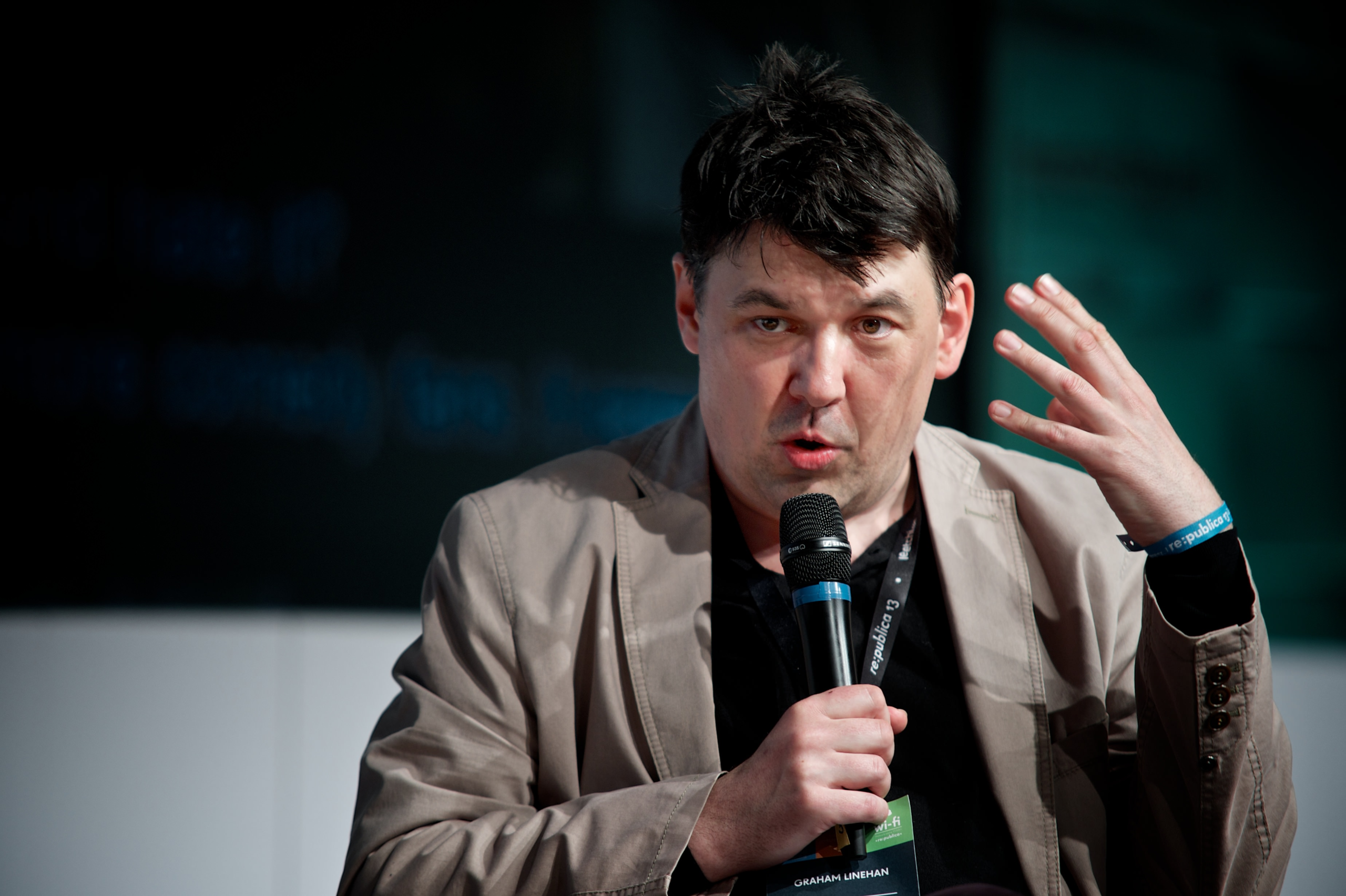
Graham Linehan once made his name writing clever, absurdist sitcoms , Father Ted, Black Books, The IT Crowd. Today, he is better known for a very different project: a relentless campaign against transgender people that has consumed his reputation, career, and personal life.
This campaign has been costly. At the beginning, Linehan was banned from Twitter and had work pulled from streaming platforms. His public life has increasingly become intertwined with police investigations, court proceedings and legal disputes. He was arrested at Heathrow Airport in 2025 on suspicion of incitement to violence before later receiving an apology and compensation from the Metropolitan Police when no charges followed. He also faced criminal proceedings arising from an incident involving teenage trans activist Sophia Brooks, ultimately succeeding in overturning his criminal damage conviction on appeal. Whatever the eventual legal outcomes, the contrast with the career of an award-winning television writer is striking: courtroom reporting and culture-war controversy now generate more headlines than new creative work.
Over time, Linehan’s online persona has come to eclipse almost everything else he has done. His account on X no longer resembles that of a comedy writer reflecting on his work or engaging with culture more broadly. Instead, it is dominated by a near-constant stream of childish posts about transgender people, often accompanied by photographs of individual trans women, confrontational exchanges with critics, insults, profanity, and emotionally charged commentary. The tone frequently shifts from political argument to personal mockery, giving the impression of someone increasingly defined by online conflict rather than creative achievement. For many observers, the account reads like someone trapped in an endless cycle of outrage, where every disagreement becomes another public confrontation and every day revolves around the same grievance.
To understand Linehan’s trajectory, it helps to look back at his work. His comedies were never free of gendered or queer caricature. Father Ted mined laughs from priests panicking in lingerie aisles, “emasculated” pop singers declaring they had “no willy,” or local women recalling a man being forced into a bra during a break-in. The IT Crowd notoriously featured an episode, “The Speech,” where a trans woman’s identity was played as a punchline leading to physical violence – an episode later removed from Channel 4’s streaming service after widespread criticism.
The episode in Father Ted with the character whose defining joke is that he repeatedly insists he has no willy. Viewed today, the scene feels like an awkward relic of an era when mocking gender variance was considered an easy laugh. In retrospect, it also foreshadows the themes that would later dominate Linehan’s public campaigning: an enduring preoccupation with policing genitalia, treating departures from traditional masculinity as inherently absurd, and turning gender non-conformity into the joke itself rather than the prejudice surrounding it.
The unusually frequent appearance of jokes centred on gender non-conformity, queer identities, and masculinity under threat was noticeable from the beginning. Transgender people, cross-dressing, “men in dresses,” hidden identities, and anxieties about masculinity became recurring comic devices. At the time these themes were largely dismissed as edgy comedy or products of their era, allowing them to pass with relatively little scrutiny. In hindsight, however, they appear more like the foundations of a worldview that would later emerge openly in his public campaigning. The hostility that now defines his activism did not appear from nowhere. It can be seen, in embryonic form, woven through much of his comedy, where prejudice was softened by a laugh track and presented as entertainment rather than ideology.
These were not isolated gags. They reveal a pattern: trans and queer people reduced to props, punchlines, or threats to masculinity. What critics now call Linehan’s “activism” looks less like a sudden break and more like an extension of longstanding tropes in his comedy.

After his career in TV declined, Linehan found a new stage online. Instead of scripts, he used Twitter threads, Substack posts, and media appearances to wage a one-man war against trans women and those who support them.
The content is familiar: trans women depicted as predators in “women’s spaces,” warnings of societal collapse, accusations against charities and activists. He recycles the same “deception” stereotypes that underpinned April’s storyline in The IT Crowd. The difference is that now, instead of a laugh track, he has an online echo chamber.
These are not the consequences of “cancel culture,” as he claims, but of behaviour that harms real people and violates the law. The temptation is to psychoanalyse – is he projecting, repressing, or seeking attention? What can be said with certainty is that Linehan has made anti-trans activism his identity. He has lost work, friends, and even his marriage over it, yet continues, seemingly fuelled by the notoriety itself.
Trans liberation challenges rigid binaries, traditional gender roles, and the same Catholic moral order that Father Ted once satirised. For those invested in those binaries, the rise of trans visibility feels like a threat. Linehan has chosen to fight it, and in doing so, has exposed just how fragile the cultural authority of cisgender men can be.
Linehan is not alone. He is part of a wider network of so-called “gender critical” campaigners who mobilise moral panic to roll back rights. But his story is instructive: a once-celebrated writer who replaced creativity with cruelty, and ended up defined not by laughter but by litigation.
Trans people deserve better than to be anyone’s punchline or punching bag. And society deserves better than to let bitterness masquerade as principle.
The clearest symbol of Linehan’s decline is what now passes for his comedy career. Once one of Britain’s most successful sitcom writers, he now appears at small venues and pub function rooms as part of the Comedy Unleashed circuit, a project built around the idea of “cancelled” comedians rather than mainstream success. Linehan has openly acknowledged that he is not a stand-up comedian, yet stand-up has become one of the few public outlets still available to him. Increasingly, the performances are marketed less around comedy than around his notoriety, his anti-trans activism, and grievances about cancellation. Appearances themselves are often cancelled after venues or promoters became aware of his involvement, reinforcing a cycle in which controversy becomes both the product and the promotion. The result is a striking contrast with the career that once saw millions watching his television work, now playing a local pub to a handful of people. Instead of creating the next Father Ted or Black Books, he now tours the culture-war circuit, performing before sympathetic audiences where political identity often seems to matter more than comic originality.
Today, Graham Linehan stands as a striking example of how political obsession can eclipse creative achievement. His television career has never recovered, his name is now more commonly associated with anti-trans campaigning than comedy, and his public life revolves around social media activism, legal disputes and culture-war appearances rather than new creative work. Although he recently secured a £25,000 settlement and an apology from the Metropolitan Police over his 2025 arrest, and successfully overturned his criminal damage conviction on appeal, those legal victories have done little to alter the broader trajectory of his public life. His legacy is increasingly measured not by Father Ted or Black Books, but by years spent fighting a small, vulnerable minority. Rather than being remembered as one of Ireland’s finest comedy writers, he has become a cautionary tale of how talent can be consumed by ideological fixation until the campaign itself becomes the only remaining career.
Note: This article is written based on publicly reported facts about Linehan’s comedy, activism, arrests, and ongoing cases. It avoids speculation on private motives while highlighting patterns of behaviour, legal context, and social impact.
Read More:
- Ken O’Flynn: Using the Memory of Murdered Gay Men to Attack Trans People
- The Curious Rise of Róisín Michaux
- Bullying Victim to Bully: How Niall Boylan Built a Career Targeting Trans People
- Philip Dwyer: A Career Built on Hating Trans People.
- The Network Behind Women’s Space Ireland
- Niamh Uí Bhríain Repeal to Repression: How Niamh Uí Bhriain Recycled Ireland’s Defeated Anti-Abortion Machine into an Anti-Trans Campaign
- Helen Joyce From Trinity to Targeting Trans Lives: Helen Joyce and the Hypocrisy Ireland Keeps Importing
- Graham Linehan Why is Graham Linehan So Vehemently Anti-Trans?
- The Countess The Countess Exposed: Corporate Structure and Anti Trans Politics
- Natural Women’s Council The Natural Women’s Council and the politics of organised intimidation
- Wicklow Women4Women
- Sharon Keogan
- Peadar Tóibín The Danger Already Inside The Room
- Ken O’Flynn Using The Memory Of Murdered Gay Men To Attack Trans People
- Linda de Courcy
- Shaun Crowe
- Derek Blighe
- Paddy O’Gorman From Tights To Fragile Masculinity