
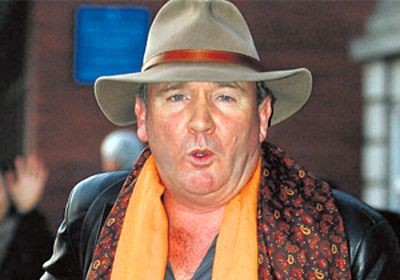
Paddy O’Gorman, who once found himself in court over published claims that he spoke about liking to wear women’s tights and missing masturbation, during his time on Celebrity Farm, has since recast himself as a leading Irish voice attacking trans and non-binary people following his retirement from RTÉ in 2022.
The tights controversy emerged during his 2007 to 2008 libel action against the Ireland on Sunday, now the Irish Mail on Sunday. The newspaper had described his behaviour on the RTÉ reality programme as strange and bizarre, he was described as an oddball, and referenced comments attributed to him about tights and masturbation. The case was settled on consent. Court reporting also referenced comments to fellow contestants including Twink and Mary Coughlan, in which he was said to have suggested that tensions arose because they fancied him. This cemented a public association between O’Gorman, cross-dressing, performative laddishness, and a defensiveness around how his masculinity was perceived.
Reporting from the case and from those who shared the set with him painted a picture that jarred sharply with his public persona. Twink was described in coverage as having had a particularly strained relationship with O’Gorman, while Mary Coughlan was cited in court reports as being on the receiving end of remarks that reduced friction to sexual attraction. The suggestion that accomplished women fancied him reframed their discomfort as flirtation and their criticism as vanity. His claim to be a defender of women doesn’t pass the mildest of scrutiny
His defensiveness runs directly into his current fixation. After four decades building a career on inserting himself into the lives of people in crisis for RTÉ, O’Gorman left the broadcaster and rapidly moved to culture war commentary. Through Paddy’s Podcast and regular contributions to Gript Media and Genspect, he has positioned himself as a crusader against what he, and the Vatican calls gender ideology, with trans women framed as a threat to women’s spaces and children’s wellbeing.
The trajectory mirrors that of Graham Linehan, another Irish media figure whose public profile shifted dramatically after being criticised over trans-related commentary. In both cases, professional challenge and reputational strain were followed by doubling down. What began as controversial remarks evolved into full-time campaigning. The perceived questioning of their authority and masculinity appears to have metastasised into grievance-driven politics, with trans people cast as the embodiment of cultural decline.
O’Gorman’s current output is repetitive, adversarial, and centred on the idea that trans inclusion represents a societal betrayal. He has attacked the 2015 Gender Recognition Act, although admitting that he didn’t speak out against it at the time, criticised pronoun use in schools, and amplified narratives about trans women in prisons and homeless hostels. He has publicly supported figures such as Helen Joyce and Linehan appearing on mainstream platforms, reinforcing a networked gender-critical ecosystem.
What makes this particularly troubling is how it reuses his long-standing method of having access to, and interviewing marginalised women. Throughout his RTÉ career he was rightly criticised for exploitation. He would arrive in dole queues, outside courtrooms, in addiction services or emergency accommodation, microphone extended. The women now featured on his podcast are frequently in prison, in direct provision, or in homelessness services. They are navigating trauma, poverty, addiction, or state neglect. In that context, we can ask whether he is genuinely empowering them or collecting testimony to validate his narrative.
When a public figure’s masculinity has been publicly mocked or destabilised, whether through courtroom revelations about tights or televised portrayals of awkwardness and ego, one response can be a hypercorrection. His move toward rigid biological essentialism and an aggressive policing of gender boundaries is possibly functioning as a reassertion of his control. His hostility toward trans people is most likely less about safeguarding women and more about restoring his threatened male authority.
O’Gorman rarely engaged in sustained feminist advocacy during his forty years in mainstream broadcasting. There was no long campaign on domestic violence funding, childcare inequality, reproductive healthcare access, or systemic misogyny. The sudden discovery of a singular concern for ‘biological women’ coinciding with retirement and the launch of an independent media brand deserves scrutiny. Far Right selective feminism only activates when trans rights are involved.
Organisations such as TENI and other LGBTQIA+ groups have repeatedly warned that his rhetoric contributes to stigma and fear. Trans and non-binary people in Ireland already face disproportionate discrimination in housing, employment, and healthcare. Framing them as intruders in women’s spaces does not address the chronic underfunding of those spaces. It redirects anger away from state failures and toward a minority.
O’Gorman’s own publications are not balanced examinations of trans lives. His attempted reinvention trades on the authority of a long broadcasting career while discarding the ethical obligations that once accompanied it. The tights controversy may have been legally settled, but his attempt to correct his public identity has potentially done far more damage to his legacy than any tabloid article ever did.
What remains is a veteran broadcaster who, faced with a changing understanding of gender, a fear of his perception by the public, and a perceived erosion of his traditional male authority, chose to attack a small, already marginalised community.
It is 2026, nobody would have cared about a man liking to wear tights.. His documented interactions with women however, will never be accepted.