
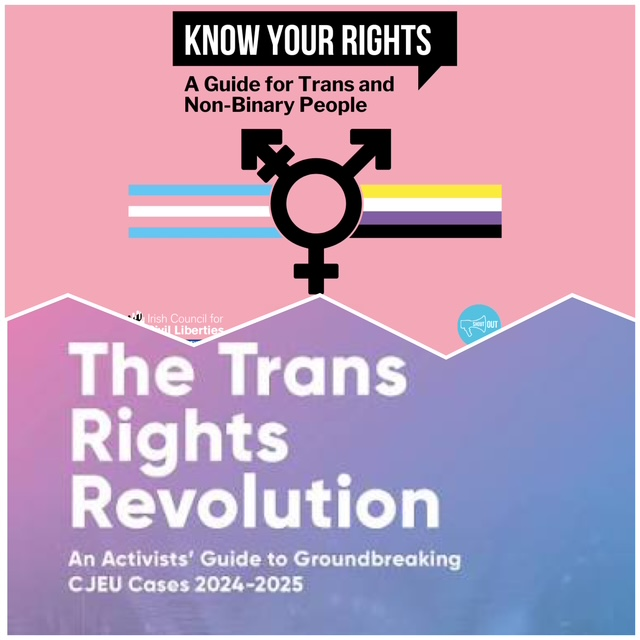
This week should have felt like progress. TENI and ICCL launched their Know Your Rights guide for trans and non binary people, a clear and practical map of the protections we are meant to have in Irish law. TGEU released its new toolkit, The Trans Rights Revolution, distilling four major CJEU cases into something activists and communities can use to demand real change across the EU [2][3].
It should have been a week about expansion, clarity, empowerment.
Instead, RTÉ reported that Ireland’s National Gender Service is closing its waiting list due to resourcing concerns [4] . The gap between law and lived experience has never been more painfully visible.
We now have rights on paper. What we do not have is a route to use them.
The Know Your Rights guide is the most comprehensive rights document for trans and non binary people ever produced in Ireland [1]. It explains everything from gender recognition to workplace equality to safety in schools and access to healthcare. It treats trans people as rights holders, not problems to be managed. It is practical, written with care, and grounded in the realities of daily life.
It is also built on a binary legal system that still refuses to recognise non binary people and barely acknowledges intersex people at all [1]. The guide can only work with the legal architecture we have, and our architecture is structurally narrow. It offers clarity, but not completeness.
Alongside this, TGEU’s new toolkit brings the EU dimension into sharp focus. The Mirin, Mousse, Deldits and Shipov judgments from the Court of Justice of the European Union set new standards across areas like workplace equality, parental rights and access to documents. They tell us that discrimination against trans people is not just immoral but unlawful, that member states are required to deliver equal treatment, and that excuses about administrative burden do not hold.
But what do these victories mean if, in Ireland, a trans person cannot even get on a waiting list for basic gender identity care? What is the value of a CJEU decision on discrimination when the national health service responds by refusing to see you at all?
This is the contradiction at the heart of Irish trans life right now. Our rights are expanding in theory just as the institutions charged with delivering them begin to retract in practice.
Take the Mousse judgment. The CJEU was clear that an employer cannot rely on social discomfort or national habits to justify discrimination [2][3]. Equality must be substantive.
Try explaining that to a trans woman in Ireland who has waited years, sometimes close to a decade, for a first appointment at the NGS. The waiting list is now closed, not because need has fallen but because the service has chosen restriction over reform [4].
Or look at the Shipov case, where the Court held that inaccurate or outdated personal data can constitute a breach of rights [2][3]. Contrast that with Irish health systems where trans and non binary people are routinely misgendered because documentation systems were not built with us in mind.
EU case law raises the standard. Irish practice undermines it.
The CJEU imagines a Europe striving toward equality. Ireland replies with administrative silence.
Rights without routes are promises without pathways. They become symbolic rather than functional.
The TENI and ICCL guide shows trans people how to claim what the law says belongs to them [1]. The TGEU toolkit shows activists how to use EU law to push for change [2]. Both documents are powerful.
But the closure of the NGS waiting list exposes a blunt truth. A right you cannot exercise is not a right at all. A legal framework that cannot be accessed becomes a stage set rather than a safety net.
Ireland has mastered progressive language. It has not mastered progressive delivery.
Even in a week framed as a milestone, intersex people remain largely absent from the story.
The Know Your Rights guide is strong, but it is primarily trans focused and does not fully address intersex rights or the ongoing medical violations that intersex people in Ireland still face [1]. That reflects our law, which treats intersex variations as medical anomalies rather than protected identities.
At OII Europe gatherings, including the most recent event in Athens, it is painfully clear that intersex activists are pushing against systemic invisibility, fighting for bans on non consensual surgeries, adult pathways, and basic recognition [10]. Intersex realities must be built into the next iteration of any rights framework in Ireland. Not as an add on. As a core component.
We cannot build a rights landscape that includes only two of the three communities most affected by medicalised gender regulation.
So what do we do with this week?
We recognise that rights documents must be met with strategy and pressure. EU case law gives us leverage, but only mobilisation forces governments to act. We acknowledge that the Irish state often performs equality at European level while withholding it domestically.
Most importantly, we name what is happening. The closure of the waiting list is not a neutral administrative step. It is a political choice that narrows trans futures while the law pretends to expand them [4].
Ireland can choose to align its systems with the rights revolution emerging across Europe. Or it can continue constructing a parallel universe where rights exist in theory while access collapses in practice.
The CJEU gives us language. TENI and ICCL give us tools. Intersex activists give us a blueprint for bodily autonomy grounded in community.
What we lack is the route.
Not another promise. A pathway to care. A pathway that turns symbolic rights into lived ones.
Until then, we will keep doing what we have always done. We will organise. We will document, and we will insist that rights without routes are not enough.
References
- TENI & ICCL (2024). Know Your Rights: A Guide for Trans and Non Binary People in Ireland. Transgender Equality Network Ireland and Irish Council for Civil Liberties. Available at: https://www.teni.ie
- TGEU (2024). The Trans Rights Revolution: An Activists’ Guide to Groundbreaking CJEU Cases. Transgender Europe. Available at: https://tgeu.org
- Court of Justice of the European Union (CJEU). Judgments summarised in TGEU toolkit:
- Mirin v Caisse nationale d’assurance pension (C 447/21)
- Mousse v Prefecture de Police (C 560/21)
- Deldits v Luxembourg (C 356/21)
- Shipov v Transalpine ÖBB (C 243/22)
- RTÉ News (2025). “National Gender Service to close transgender care waiting list due to resourcing concerns”. RTÉ Prime Time, 11 December 2025. Available at: https://www.rte.ie/news/primetime/
- Ní Fhaoláin, S. (2025). Trans Health Access: Literature Synthesis and Key Considerations for Inclusive Care. Internal research document, Simply-Sorcha.com.
- Peitzmeier et al. (2014–2020). Key studies on cervical screening access for trans and gender diverse people as synthesised in Ní Fhaoláin (2025).
- Bowring et al. (2019). Evidence on self-sampling and inclusive screening environments as synthesised in Ní Fhaoláin (2025).
- Kirkland & Bauer (various years). Analyses of trans health disparities referenced in Ní Fhaoláin (2025).
- White Hughto & LeBlanc et al. (2020). Structural drivers of trans health inequity summarised in Ní Fhaoláin (2025).
- OII Europe (2023–2025). Advocacy materials and community insights on intersex rights and EU policy. Available at: https://oiieurope.org